
The Autism Mom Oxygen Mask Principle: Essential Self-Regulation Strategies for Caregiver Well-Being
The Autism Mom Oxygen Mask Principle: Essential Self-Regulation Strategies for Caregiver Well-Being
Why Emotional Regulation Is Non-Negotiable for Autism Moms
Autism Parenting Stress Is Not Ordinary Stress
The Problem With Most Self-Care Advice
How Parental Resilience Actually Develops
What Happens When Caregiver Stress Goes Unaddressed
Self-Regulation Tools That Fit Real Life
Mindfulness Without the Nonsense
Daily Self-Care Has to Be Reframed
When Professional Mental Health Support Is Needed
Key Takeaways
The Oxygen Mask Principle means autism moms need nervous system support, not just more parenting strategies.
Parent regulation in autism is not about being perfectly calm; it is about increasing your capacity to respond, recover, and repair.
Autism parenting stress is often cumulative because it includes emotional labor, advocacy labor, sensory vigilance, and chronic unpredictability.
Self-care advice often fails autism moms when it ignores access, support, childcare, sleep, money, and systems-level stress.
Mental health support for autism families should be treated as protective care, not a last resort.
Small regulation practices, fewer words, longer exhales, lowered demands, and repair, can help reduce escalation over time.
A depleted mother is not a sustainable intervention plan.
There is a version of autism motherhood people talk about publicly: the advocacy, the therapy appointments, the sensory tools, the school meetings, the research, the routines.
And then there is the version many mothers live quietly.
The version where you wake up already bracing. Where your shoulders are somewhere near your ears before breakfast. Where one more sound, one more request, one more school email, one more transition, one more “quick question” feels like it might push you past the edge of yourself.
You love your child fiercely. That was never the question.
But love does not erase nervous system depletion.
And that is the part we need to start talking about more honestly.
The Autism Mom Oxygen Mask Principle is simple:
Your regulation is not extra. It is part of the care plan.
Not because mothers should be endlessly calm, endlessly patient, or endlessly available. That expectation is part of the problem.
The point is not to become a soft-spoken regulation goddess who glides through meltdowns with herbal tea and perfect eye contact.
The point is that your nervous system is living inside this too.
And if your body is constantly operating in survival mode, no amount of parenting scripts, sensory bins, visual schedules, or expert advice will land the way it is supposed to.
Because you are not a machine executing strategies.
You are a human being trying to parent from inside a body that may not feel safe yet.
Why Emotional Regulation Is Non-Negotiable for Autism Moms
Emotional regulation is often talked about as if it means “staying calm.”
That is far too shallow.
For autism moms, regulation is not about maintaining a pleasant tone while everything is falling apart. It is the ability to notice what is happening in your body before your stress response takes the wheel.
It is the moment you realize:
My jaw is tight.
My chest is hot.
I am talking faster.
I am interpreting this moment as danger.
I need to slow down before I respond.
That pause matters.
Not because it makes you perfect. Because it gives you a chance.
When you are parenting an autistic child, especially a child who experiences sensory overwhelm, communication frustration, anxiety, elopement, shutdowns, or meltdowns, your nervous system becomes part of the emotional environment.
This does not mean your child’s regulation is your fault.
Let’s not turn co-regulation into another way to blame mothers. We have more than enough of that.
It means your steadiness can become useful information for your child’s body.
That may look like:
A slower voice.
A less urgent face.
Fewer words.
A little more space.
A body that says, “I am here. We are not in danger. We can move through this.”
That kind of presence is hard to access when you are already depleted.
So when we talk about parent regulation in autism, we are not talking about some fluffy wellness concept. We are talking about capacity.
The capacity to stay connected to yourself while your child is struggling.
The capacity to respond instead of react.
The capacity to repair when you do react, because you will.
And that capacity has to be protected.
Autism Parenting Stress Is Not Ordinary Stress
A lot of general parenting advice collapses under the weight of autism parenting because it was never built for this nervous system load.
Autism moms are often doing a type of invisible labor other people do not even know to look for.
For example:
You are not just taking your child to the grocery store.
You are scanning the lighting, the noise, the exits, the cart situation, the snack status, the transition out, and whether the woman in aisle four is about to say something ignorant.You are not just sending your child to school.
You are wondering whether the environment is too loud, whether the supports are being followed, whether the teacher understands the difference between defiance and overload, and whether your child will hold it together all day only to collapse the second they get home.You are not just attending an appointment.
You are translating your child to the provider, the provider to your child, the jargon to yourself, and your gut instinct into language that will be taken seriously.
That is not “being dramatic.”
That is cognitive, emotional, sensory, and advocacy labor running at the same time.
And the body keeps score.
Over time, your system may start treating ordinary moments as potential threats because, frankly, a lot of ordinary moments have become unpredictable.
This is why burnout in autism caregiving can feel so deep.
It is not simply that you are tired.
It is that your nervous system has had too little recovery between too many demands.
The Problem With Most Self-Care Advice
Here is where we need to be very clear: most self-care advice for autism moms is underdeveloped.
It is not wrong, exactly.
It is just incomplete.
Yes, these things matter:
Sleep.
Movement.
Nutrition.
Time alone.
Therapy.
Friendship.
Joy.
Rest.
But telling an autism mom to “take a break” without acknowledging whether she has childcare, money, support, sleep, school cooperation, or a safe person to leave her child with is not care.
It is a slogan.
And autism moms do not need more slogans.
They need support that understands the actual shape of their life.
Self-care cannot become another performance metric. It cannot become one more area where a mother looks at herself and thinks, “Great, I’m failing at this too.”
A better question is not:
“Why aren’t you taking better care of yourself?”
A better question is:
“What is keeping care from being accessible?”
That question changes everything.
Because now we are not blaming the mother for being depleted. We are looking at the ecosystem around her.
Questions worth asking include:
Does she have real respite?
Does her partner understand the invisible labor?
Does the school support her child appropriately?
Does she have mental health support that understands autism family stress?
Does she have people who can sit with the truth without rushing to fix it?
Does she have permission to lower demands without calling herself lazy?
This is where mental health support for autism families becomes essential.
Not as a crisis intervention after the mother is already completely undone, but as a protective part of family life.
How Parental Resilience Actually Develops
Resilience is another word that gets misused.
Sometimes people say “resilience” when they really mean:
Keep functioning no matter how much this costs you.
That is not resilience.
That is endurance.
And endurance without recovery becomes collapse.
Real resilience is not the ability to be unaffected. It is the ability to be affected and still find your way back.
For autism moms, resilience often develops through small internal shifts:
You recognize your own overload earlier.
You stop assuming every hard moment means you handled it wrong.
You learn which demands can be lowered and which truly matter.
You stop confusing control with safety.
You repair faster after rupture.
You build a life that works with your family’s nervous systems instead of forcing everyone into environments that were never designed for them.
That last piece is important.
Sometimes the most regulating thing an autism family can do is stop trying to look like every other family.
That might mean:
The birthday party is not worth it.
The restaurant is not worth it.
The holiday tradition needs to change.
The morning routine needs fewer steps.
The school plan needs to be challenged.
The expectation that you should do everything “normally” needs to be grieved.
This is not giving up.
It is adapting with honesty.
And honesty is regulating.
What Happens When Caregiver Stress Goes Unaddressed
When caregiver stress is ignored, it rarely stays neatly contained.
It leaks.
It may show up as:
A sharp tone you did not mean to use.
Decision fatigue.
Resentment that scares you because you love your child so much.
Numbness.
Irritability.
Anxiety.
Avoidance.
Shutdown.
Over-researching.
The inability to rest even when you finally have a quiet moment.
Unmanaged stress does not mean you do not care.
Often, it means you have cared intensely for a long time without enough places to put the weight down.
And when the parent’s nervous system is overwhelmed, the whole family system feels it.
This is not about blame.
It is about reality.
If a mother is chronically depleted, she has less access to patience, flexibility, humor, curiosity, and problem-solving.
These are not moral traits.
They are nervous system capacities.
You cannot shame yourself into having more capacity.
You restore capacity by reducing threat, increasing support, and creating recovery where you can.
Self-Regulation Tools That Fit Real Life
The best self-regulation tools are not necessarily the most impressive ones.
They are the ones you will actually use when the house is loud, the transition is going sideways, and your body is already halfway to panic.
Start here.
Tool 1: Use a Longer Exhale
Before you respond, exhale.
Not a perfect breath. Not a ten-minute breathing practice.
Just a longer exhale than inhale.
Try this:
Inhale gently.
Exhale slowly.
Drop your shoulders.
Unclench your jaw.
Say to yourself, “I only need to handle the next moment.”
Longer exhales can help cue the body toward settling and recovery.
In plain English: your body needs a signal that it is not being chased by a bear, even if the “bear” is a shoe refusal five minutes before school.
Tool 2: Reduce Language
When a child is in meltdown or near meltdown, more words often become more input.
And when you are stressed, more words can also escalate you.
You start explaining, persuading, correcting, negotiating, narrating — and suddenly no one is more regulated.
Try fewer words:
“I’m here.”
“You’re safe.”
“We’ll talk later.”
“First calm, then problem-solving.”
“Less talking now.”
This protects your child’s processing capacity and your own.
Tool 3: Lower One Demand
This is deceptively powerful.
Ask yourself:
What does not need to happen right now?
Maybe:
The shoes do not have to be the “right” shoes.
Dinner can be toast and fruit.
The errand can wait.
The email does not need an immediate response.
The goal is not a successful outing; maybe the goal is leaving before everyone is fried.
Lowering demands is not permissiveness.
It is nervous system math.
When demand exceeds capacity, escalation becomes more likely. When you reduce unnecessary demand, you create room for regulation.
Mindfulness Without the Nonsense

Mindfulness can be helpful for autism caregivers, but we need to rescue it from the land of vague wellness language.
Mindfulness is not about emptying your mind.
Good luck with that when you are mentally tracking appointments, lunch preferences, sensory triggers, insurance claims, and whether the school team actually read the IEP.
Mindfulness is the practice of coming back to the present moment without immediately attacking yourself for what you find there.
That might look like:
Noticing your feet on the floor.
Unclenching your hands.
Stepping outside for thirty seconds.
Letting the air hit your face.
Saying, “This is a hard moment,” instead of, “I am a terrible mother.”
That shift matters.
Because shame accelerates dysregulation.
Compassion creates a little room.
And sometimes a little room is enough to choose the next response instead of being swallowed by the first impulse.
Daily Self-Care Has to Be Reframed
Daily self-care for autism moms should not begin with the question:
“What can I add?”
Most autism moms do not need more things added to their day.
A better starting point is:
“What can I remove, soften, simplify, or stop pretending is sustainable?”
That may mean:
Simplifying meals.
Saying no to social plans that require too much recovery.
Asking your partner to own an entire category of labor rather than “helping” when asked.
Choosing the supportive school meeting over the polite one.
Admitting that the current schedule is not working.
Letting yourself rest without first earning it through collapse.
Self-care is not always a candle.
Sometimes it is a boundary.
Sometimes it is a cancellation.
Sometimes it is a paper plate.
Sometimes it is refusing to explain your child to someone committed to misunderstanding them.
Sometimes it is deciding that your body is allowed to be considered in the family plan.
Why Support Networks Matter
Support networks are not just nice to have.
They are protective.
Isolation makes everything louder.
When you have no place to say the real thing, the real thing stays trapped in your body. And autism motherhood comes with plenty of real things many people do not know how to hear.
You need people who can hear:
“I love my child and I am exhausted.”
“I am scared about the future.”
“I hate how judged I feel in public.”
“I do not recognize myself right now.”
“I need help, but I do not even know what help would look like.”
The right support does not rush to silver-line everything.
It does not say, “But you’re so strong.”
It does not turn your pain into inspiration before you have had a chance to feel it.
Good support helps your nervous system stop performing.
That might come from:
A therapist.
A trusted friend.
A support group.
A partner who is willing to learn.
A community of parents who do not need the whole backstory explained.
Being understood is not a luxury.
It is regulating.
When Professional Mental Health Support Is Needed
There are seasons when self-regulation tools are not enough on their own.
Professional support may be especially important if you are:
Constantly overwhelmed.
Frequently crying.
Feeling numb or detached.
Having panic symptoms.
Unable to sleep even when your child sleeps.
Feeling hopeless.
Having thoughts of disappearing or not wanting to be here.
You do not have to wait until you are in crisis to deserve help.
Therapy can give you a place to process the grief, anger, fear, identity shifts, and chronic stress that often come with autism parenting.
For some mothers, medication may also be part of appropriate support.
For others, group therapy, somatic work, trauma-informed care, or respite services may be the missing piece.
There is no gold star for suffering privately.
And there is no shame in needing more than a breathing technique.
Sometimes the most regulated thing you can do is tell the truth about how much support you need.
Repair Is Part of Regulation
Even with every tool in the world, you will still have moments you do not love.
You will yell sometimes.
You will sound harsher than you meant to.
You will push too hard.
You will miss the signs.
You will realize too late that your child was overloaded, not oppositional.
This is where repair becomes essential.
Repair is not a dramatic apology tour.
It is a return to connection.
It can be simple:
“I’m sorry I yelled. I was overwhelmed. That was my responsibility.”
“That got hard for both of us. I love you. We’re okay.”
“I’m going to try again with a calmer voice.”
“I missed what was happening. I understand more now.”
Repair teaches your child that relationships can survive hard moments.
It also teaches your nervous system that mistakes are not emergencies.
They are moments to come back from.
That is a profound lesson in a family system.
The Oxygen Mask Principle in Practice
The Oxygen Mask Principle is not about putting yourself first in a way that abandons your child.
It is about refusing to disappear while caring for your child.
It is about understanding that your child’s needs are real, and so are yours.
It is about recognizing that a depleted mother is not a sustainable intervention plan.
It is about building a family rhythm where the mother’s body is not treated as the unlimited resource everyone gets to draw from without replenishment.
This does not require a perfect routine.
It begins with small, honest shifts:
Pause before responding.
Use fewer words when everyone is overloaded.
Lower one unnecessary demand.
Let something be good enough.
Ask for support before resentment becomes the only signal left.
Repair when you miss it.
Stop measuring your motherhood by how well you can function while depleted.
That last one may take time.
Most important things do.
Final Thoughts
Autism moms are often handed strategies for their children long before anyone asks what their own nervous system has been carrying.
But your regulation matters.
Not because you are responsible for making every hard moment calm.
Not because you should be endlessly patient.
Not because your child’s meltdowns are your fault.
Your regulation matters because you are part of the system too.
And when you begin tending to your own body with the same seriousness you bring to your child’s needs, something shifts.
Not instantly.
Not perfectly.
But meaningfully.
You stop seeing your exhaustion as a personal defect.
You start recognizing it as information.
And from there, you can begin building support that actually matches the life you are living.
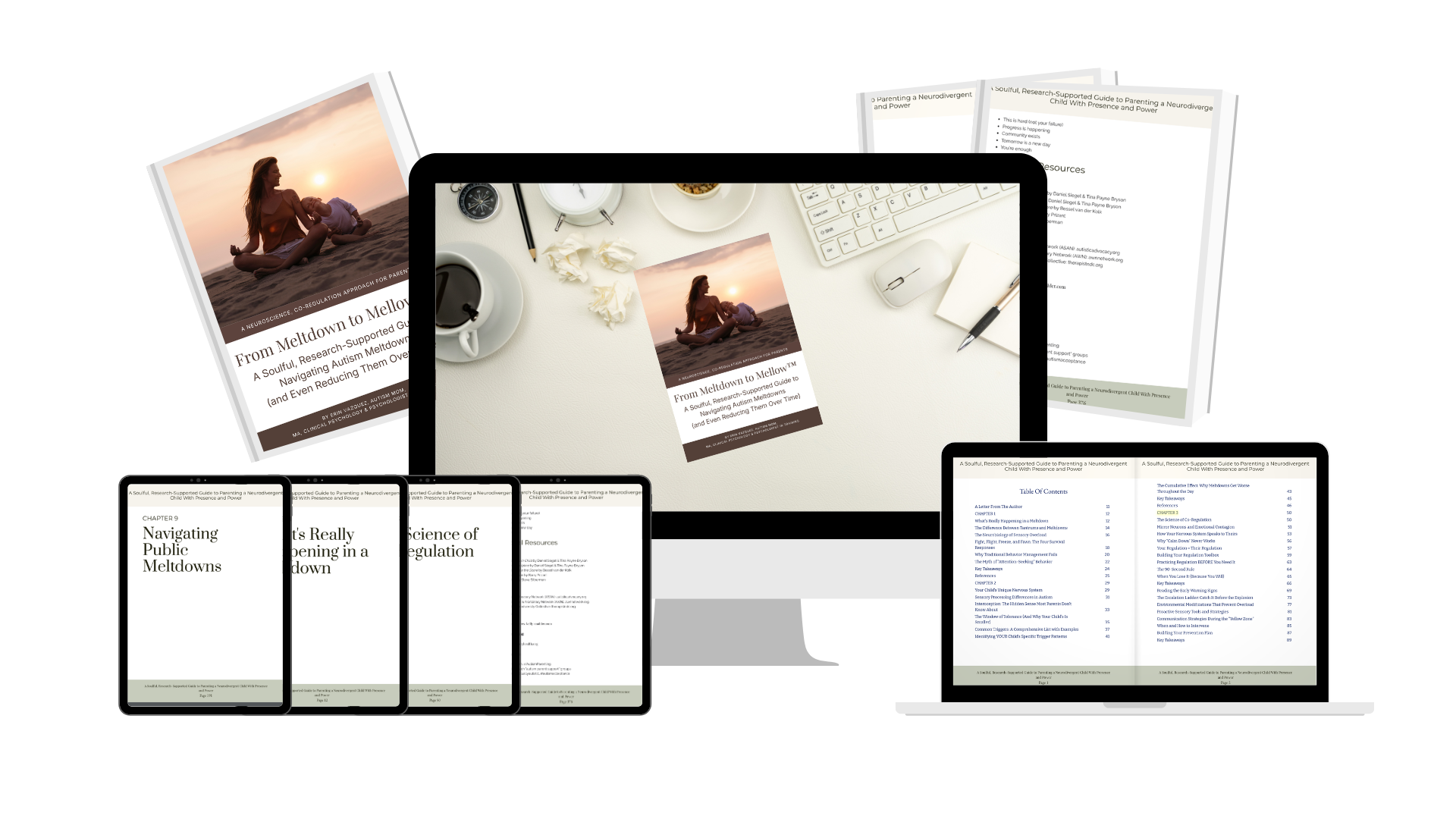
If this article helped you understand your own nervous system with more clarity, you’ll find more inside From Meltdown to Mellow™, where I go deeper into meltdowns, co-regulation, repair, sensory overwhelm, and parent nervous system protection.
References
Drogomyretska, K., Fox, R., & Colbert, D. (2020). Brief report: Stress and perceived social support in parents of children with ASD. Journal of Autism and Developmental Disorders, 50, 417–422. https://doi.org/10.1007/s10803-019-04259-x
Estes, A., Munson, J., Dawson, G., Koehler, E., Zhou, X.-H., & Abbott, R. (2009). Parenting stress and psychological functioning among mothers of preschool children with autism and developmental delay. Autism, 13(4), 375–387. https://doi.org/10.1177/1362361309105658
Ruiz-Robledillo, N., Sariñana-González, P., Pérez-Blasco, J., González-Bono, E., & Moya-Albiol, L. (2015). A mindfulness-based program improves health in caregivers of people with autism spectrum disorder: A pilot study. Mindfulness, 6, 767–777. https://doi.org/10.1007/s12671-014-0316-0
Vazquez, E. (n.d.). From Meltdown to Mellow™: A science-backed guide for using connection to navigate, and even reduce, autism meltdowns starting with the next one [PDF guide].