

How to Conquer Anticipatory Dread as an Autism Mom
Let’s be honest about the word “conquer.”
Because if you are an autism mom living with anticipatory dread, the last thing you need is another message telling you to be stronger, tougher, calmer, more positive, or more “resilient.”
You are already strong.
You have been strong in school meetings.
Strong in waiting rooms.
Strong in grocery store aisles.
Strong during meltdowns.
Strong while crying in the car afterward.
Strong while researching therapies at midnight.
Strong while pretending you were okay because no one around you knew what to do with your grief.
So when we talk about how to conquer anticipatory dread as an autism mom, we are not talking about overpowering your nervous system.
We are talking about helping your body stop living like disaster is always five minutes away.
You do not conquer dread by shaming yourself into bravery.
You conquer it by restoring enough internal safety that dread no longer gets to make every decision.
For the full framework, read the complete guide to anticipatory dread in autism parenting.
What Does It Mean to Conquer Anticipatory Dread as an Autism Mom?
To conquer anticipatory dread as an autism mom means learning how to calm your nervous system, prepare without spiraling, respond instead of react, and rebuild trust in your ability to handle hard moments. It does not mean never feeling anxious. It means dread no longer controls your parenting, your calendar, or your sense of self.
That distinction matters.
Because a lot of moms hear “conquer anxiety” and think:
I need to stop feeling this.
I need to be calm all the time.
I need to stop dreading outings.
I need to become the kind of mom who can handle anything.
No.
The goal is not to become untouchable.
The goal is to become anchored.
Step 1: Stop Calling It Weakness
The first step is to stop turning dread into a moral failure.
Anticipatory dread is often a nervous-system response. Your body remembers previous moments of overwhelm, danger, public judgment, confusion, or helplessness and begins preparing before the next similar situation happens.
That can look like:
irritability before leaving the house
a tight chest before school pickup
stomach tension before appointments
over-planning before family events
avoiding outings because they feel too expensive
rehearsing disaster before anything has gone wrong
This is not weakness.
It is bracing.
Autism Mom Help’s positioning names this hidden problem clearly: after diagnosis, autism moms often live in chronic stress activation but interpret that overload as personal failure. The deeper issue is not inadequacy; it is nervous-system destabilization.
So the first sentence changes from:
“What is wrong with me?”
To:
“My body is trying to protect me.”
That shift alone can soften the shame.
Step 2: Regulate Before You Problem-Solve
When dread hits, your brain may want to solve everything immediately.
What if he melts down?
What if she refuses to leave?
What if the teacher says something?
What if my family judges me?
What if I lose my patience?
What if I cannot handle it?
But an activated nervous system does not need ten more plans first.
It needs a signal of safety.
Try this before problem-solving:
Put both feet on the ground.
Drop your shoulders.
Unclench your jaw.
Take a slower exhale than inhale.
Look around and name what is true right now.
Then say:
“This is dread. It is not a prophecy.”
Research on autism caregiving consistently shows that parent carers of autistic children often report elevated stress, anxiety, and depression, and unmet parent mental health needs can affect the whole family system.
That matters because your regulation is not optional fluff.
It is family infrastructure.
Step 3: Create a Hard-Moment Plan
Anticipatory dread gets louder when your body believes you have no plan.
A hard-moment plan does not need to be complicated.
Ask yourself:
What usually overwhelms my child here?
What helps my child regulate?
What helps me stay grounded?
Where can we take a break?
What will I say if we need to leave?
For example:
“If the store gets too loud, we will go to the car.”
“If the party is too much, we will stay 30 minutes.”
“If the appointment feels overwhelming, I will ask for time before deciding.”
“If someone comments, I will not defend our entire life. I will say, ‘We’re doing what works for our child.’”
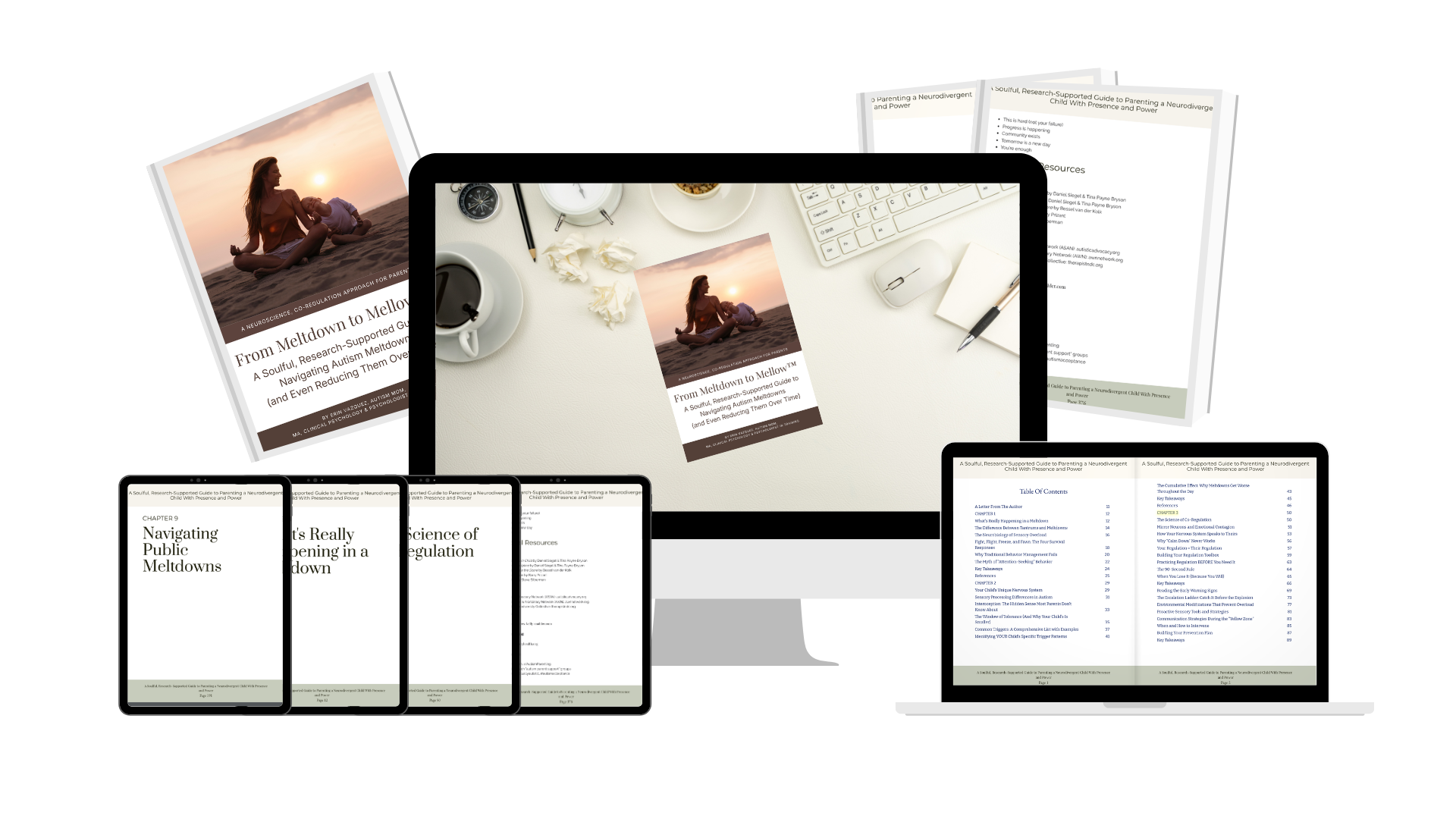
From Meltdown to Mellow™ teaches practical meltdown support through tools like the CALM Response System, public meltdown scripts, repair after hard moments, and parental nervous-system protection.
The point is not to control every outcome.
The point is to remind your nervous system:
“We are not trapped.”
Step 4: Lower the Stakes
One of the most powerful coping strategies for anxious autism moms is lowering the stakes.
Not every outing has to prove progress.
Not every school meeting has to prove you are a perfect advocate.
Not every family gathering has to prove your child can handle what everyone else expects.
Not every meltdown means the whole day is ruined.
Ask:
“What is the smallest successful version of this?”
Maybe success is:
walking into the store and buying one thing
staying at the birthday party for 20 minutes
asking one clear question in the IEP meeting
noticing your child’s early signs before escalation
leaving before everyone is completely depleted
repairing afterward instead of spiraling for three hours
This matters because dread thrives on all-or-nothing thinking.
Grounded strength grows through smaller, safer repetitions.
Step 5: Practice Regulation Before the Crisis
You cannot wait until everyone is dysregulated to practice nervous-system regulation.
That is like trying to learn CPR during the emergency.
Practice before you need it.
Try building tiny regulation moments into normal life:
three slow exhales before opening the car door
one hand on your chest before checking school messages
silence for 60 seconds after drop-off
stepping outside after a loud morning
drinking water before responding to a stressful email
softening your voice before a transition
These moments seem small.
But they teach your body that it can return.
Autistic children may experience sensory processing differences, and sensory differences can shape emotional and behavioral responses in daily environments. Autism research also describes emotion regulation challenges in autistic children and adolescents, which is one reason parent regulation and environmental support matter so much.
You are not practicing calm because your child’s distress is your fault.
You are practicing because your nervous system is one of the tools available in the room.
Step 6: Build Recovery Into the Day
A lot of autism moms are not just anxious.
They are under-recovered.
You go from school drop-off to work to therapy to dinner to bedtime to research to paperwork to worrying.
Then you wonder why your body dreads tomorrow.
Recovery is not a reward for when everything is done.
It is part of what makes tomorrow possible.
Recovery might look like:
fewer errands after appointments
quiet time after school
a low-demand dinner
canceling optional plans
sitting in the car for five minutes
asking your partner to take the next transition
not analyzing the entire day before bed
Caregivers of autistic children often experience significant stress and burden, and research points to the need for better screening and psychosocial support for caregivers.
You are allowed to design your life around capacity, not just obligation.
Step 7: Repair Instead of Ruminating
After a hard moment, dread often says:
See? You cannot handle this.
You messed it up again.
Next time will be worse.
Repair says:
That was hard.
We are still connected.
We can learn from it.
We can try again.
Repair with your child might sound like:
“I got overwhelmed too. I’m sorry I yelled.”
“You were having a hard time. I understand that now.”
“We are okay. We can rest.”
“Next time, I’ll try to notice sooner.”
Repair with yourself might sound like:
“I am not proud of every moment, but I am still a good mother.”
“I can learn without attacking myself.”
“This was information, not a verdict.”
From Meltdown to Mellow™ includes repair after meltdowns as a core piece because what happens after the hard moment can rebuild safety, connection, and trust.
You do not conquer dread by never making mistakes.
You conquer dread by learning that mistakes do not have to become identity.
Final Thoughts
So how do you conquer anticipatory dread as an autism mom?
Not by pretending you are not scared.
Not by forcing yourself to be positive.
Not by shaming your body for remembering hard things.
You begin by telling the truth:
“This is dread.”
“My body is bracing.”
“I can support myself before I solve everything.”
“I can make a plan.”
“I can lower the stakes.”
“I can leave.”
“I can repair.”
“I can recover.”
“I can trust myself again.”
That is how dread loses power.
Not all at once.
But little by little, your nervous system begins to learn:
Hard does not mean unsafe.
A meltdown does not mean failure.
Leaving does not mean losing.
Needing support does not mean weakness.
I can be overwhelmed and still be a good mom.
That is not perfect calm.
That is grounded strength.
The Deeper Nervous System Support For Your Nervous System
If your anticipatory dread is tied to the fear of another meltdown, From Meltdown to Mellow™ gives you the map your nervous system has been asking for.
Inside, you will learn what is really happening during autistic meltdowns, how to recognize early warning signs, how to use the CALM Response System, how to support your child through public meltdowns, and how to repair afterward without drowning in shame.
You do not conquer dread by trying harder.
You conquer it by finally knowing what to do.
References
Catalano, D., Holloway, L., & Mpofu, E. (2018). Mental health interventions for parent carers of children with autistic spectrum disorder: Practice guidelines from a critical interpretive synthesis. International Journal of Environmental Research and Public Health, 15(2), 341.
Mazefsky, C. A., Herrington, J., Siegel, M., Scarpa, A., Maddox, B. B., Scahill, L., & White, S. W. (2013). The role of emotion regulation in autism spectrum disorder. Journal of the American Academy of Child & Adolescent Psychiatry, 52(7), 679–688.
Robertson, C. E., & Baron-Cohen, S. (2017). Sensory perception in autism. Nature Reviews Neuroscience, 18(11), 671–684.
van Niekerk, K., Groenewald, C., & Wright, S. C. D. (2023). Caregiver burden among caregivers of children and adolescents with autism spectrum disorder. BMC Pediatrics, 23, 460.
Vazquez, E. (2026). From Meltdown to Mellow™: A soulful, research-supported guide to navigating autism meltdowns and even reducing them over time. Autism Mom Help.