
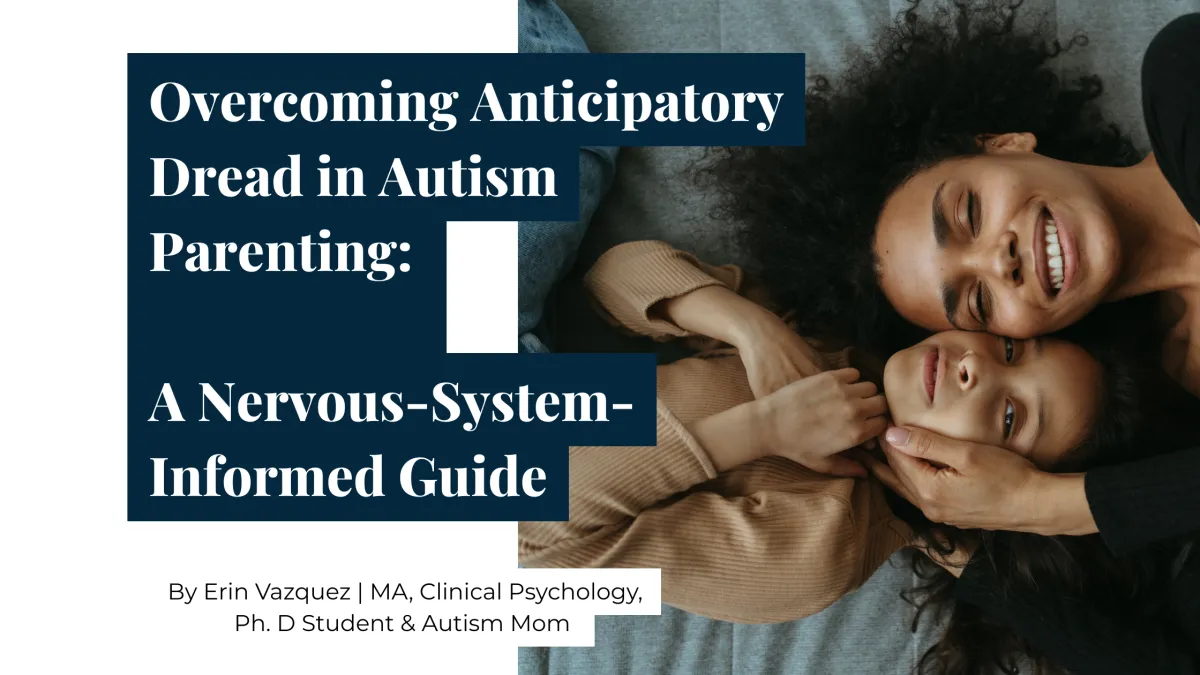
Overcoming Anticipatory Dread Autism Parenting: A Nervous-System-Informed Guide
Overcoming Anticipatory Dread Autism Parenting: A Nervous-System-Informed Guide
What Is Anticipatory Dread in Autism Parenting?
Why Autism Parents Experience Anticipatory Dread
Anticipatory Dread Is Not a Character Flaw
How Diagnosis Grief Can Feed Anticipatory Dread
The Role of Nervous System Regulation for Autism Parents
Coping Strategies for Anxious Autism Moms
1. Name the Dread Without Shaming It
2. Regulate Before You Problem-Solve
3. Prepare Without Over-Controlling
6. Build Recovery Into the Day
There is a specific kind of exhaustion that comes from living five steps ahead of disaster.
You are not just packing the sensory bag.
You are imagining the grocery store meltdown before you even find your keys.
You are not just driving to school pickup.
You are bracing for the teacher’s face, the report, the dysregulated transition, the car ride home.
You are not just accepting an invitation to a family gathering.
You are already rehearsing what you will say if your child gets overwhelmed, if someone judges you, if a relative makes a comment, if your body floods with shame before you can even think clearly.
That feeling has a name.
It is anticipatory dread.
And if you are an autism mom living with it, I want you to hear this first:
You are not weak.
You are not dramatic.
You are not failing motherhood.
Your nervous system may simply be exhausted from bracing for impact.
Autism Mom Help’s core work is rooted in this truth: many autism moms are living in chronic stress activation after diagnosis and interpreting that physiological overload as personal failure. The work is not to shame moms into coping harder. It is to restore internal ground.
What Is Anticipatory Dread in Autism Parenting?
Anticipatory dread in autism parenting is the anxious, body-based fear that something hard is about to happen before it actually does. It may show up before school, public outings, appointments, family events, transitions, or any situation where you fear a meltdown, judgment, conflict, or overwhelm.
This dread is not always logical.
You may know, intellectually, that today might be fine.
But your body remembers the last time it was not fine.
Your chest tightens.
Your jaw locks.
Your thoughts speed up.
Your patience gets thinner.
Your stomach drops before anything has even happened.
That is the brutal part of anticipatory dread: it makes you live through the hard moment before the hard moment arrives.
Why Autism Parents Experience Anticipatory Dread
Autism parenting often asks parents to carry an unusual amount of uncertainty.
You may be trying to predict sensory triggers, social expectations, transitions, communication needs, school demands, food issues, sleep issues, therapy schedules, and public judgment all at once.
That is not normal “mom stress.”
That is constant nervous-system scanning.
Research has shown that many autistic people experience sensory processing differences, and sensory input can affect emotional and behavioral regulation. Robertson and Baron-Cohen describe sensory perception as central to understanding autism, not a side issue. Mazefsky and colleagues also note that autism is associated with amplified emotional responses and emotion regulation challenges, which means parents may be navigating real neurological overwhelm, not “bad behavior.”
When your child has had meltdowns in public, struggled with transitions, or been misunderstood by adults around them, your body may start preparing for those moments before they happen.
That preparation can look like anxiety.
But underneath, it is often protection.
Your nervous system is trying to help you avoid being blindsided again.
Anticipatory Dread Is Not a Character Flaw
One of the most damaging parts of anticipatory dread is how quickly moms turn it into self-attack.
You may think:
“I should be stronger than this.”
“Other moms don’t seem this anxious.”
“Why can’t I just handle normal things?”
“I hate that I dread going places with my own child.”
“What kind of mother thinks this way?”
Let’s say the thing most people won’t say:
Sometimes you dread the outing because you are afraid of what it will cost you.
Not because you do not love your child.
Because you know what it feels like to hold your child through a meltdown while strangers stare.
You know what it feels like to leave the store shaking.
You know what it feels like to spend the rest of the day replaying what happened and wondering whether you handled it wrong.
You know what it feels like to be the emotional container, the advocate, the translator, the sensory detective, the safe person, and the one everyone expects to remain calm.
That is not weakness.
That is load.
The Autism Mom Help positioning names this clearly: moms are often given pressure, advice, and coping tools on top of exhaustion, while the deeper issue is prolonged nervous-system destabilization.
How Diagnosis Grief Can Feed Anticipatory Dread
For many moms, anticipatory dread intensifies after the autism diagnosis.
Not because the diagnosis caused the autism.
Not because the diagnosis is bad.
But because the diagnosis can mark the moment when the imagined path of motherhood collapses.
Suddenly, you may be thrown into evaluations, therapies, waitlists, insurance calls, IEP meetings, professional opinions, sensory needs, feeding questions, sleep concerns, and future fears.
And underneath all of that, there may be grief.
Grief for the ease you thought your family might have.
Grief for the version of motherhood you unconsciously expected.
Grief for how alone you feel in rooms where everyone is talking about your child, but no one is really looking at you.
The uploaded customer profile describes this mother as overwhelmed, isolated, grieving, exhausted, afraid, navigating systems that feel cold, and quietly wondering, “Who am I?”
That identity rupture matters.
Because anticipatory dread is not only about what might happen next.
Sometimes it is about who you fear you are becoming.
The Meltdown-Anxiety Loop
Anticipatory dread often becomes strongest when meltdowns are involved.
Here is the loop many moms live inside:
Your child has a meltdown.
You feel scared, judged, helpless, or ashamed.
Your body stores that experience as danger.
The next similar situation appears.
Your nervous system activates before anything happens.
You become tense, controlling, rushed, or hypervigilant.
Your child senses the pressure.
Everyone’s nervous system gets louder.
If a meltdown happens, your dread feels “confirmed.”
The loop gets stronger.
This does not mean you caused the meltdown.
It means your nervous system is part of the environment too.
From Meltdown to Mellow™ teaches that meltdowns are not tantrums or manipulation. They are nervous-system overload, and responding well begins with understanding what is happening beneath the behavior.
That understanding matters because dread grows in the dark.
When you do not understand what is happening, every meltdown can feel like proof that you are failing.
But when you understand the neurobiology, the sensory load, the escalation signs, the pre-meltdown window, and your own regulation role, the moment becomes less mysterious.
Still hard.
But less terrifying.
The Role of Nervous System Regulation for Autism Parents
Nervous system regulation for autism parents is not a luxury.
It is not a spa-day concept.
It is the foundation of how you stay connected to yourself and your child when stress rises.
The autonomic nervous system helps the body respond to cues of safety and danger. Porges’ polyvagal theory describes adaptive autonomic responses connected to safety, mobilization, and shutdown. Whether or not every part of polyvagal theory is applied clinically in the same way, the broad parenting truth is simple: when your body feels under threat, your ability to think clearly, speak gently, and respond flexibly decreases.
That is why “just calm down” is not enough.
You need body-based ways to tell your system:
“We are not in danger right now.”
“This is hard, but I am here.”
“I can take the next step.”
From Meltdown to Mellow™ reflects this through the CALM Response System, beginning with Center Yourself First before assessing the environment, lowering demands, and meeting the child where they are.
That is not selfish.
It is sequencing.
A dysregulated parent cannot easily become a regulating presence.
Coping Strategies for Anxious Autism Moms
Overcoming anticipatory dread in autism parenting does not mean you never feel anxious again.
It means dread no longer gets to run the entire house.
Here are nervous-system-informed coping strategies for anxious autism moms.
1. Name the Dread Without Shaming It
Try saying:
“This is anticipatory dread.”
“My body is remembering hard moments.”
“I do not have to treat this feeling as a prophecy.”
Naming the dread gives you a little distance from it.
You are not the dread.
You are the mother noticing dread.
That tiny distinction matters.
2. Regulate Before You Problem-Solve
When your body is activated, your mind will want to plan, control, rehearse, and predict.
But the first move is not more thinking.
The first move is regulation.
Try:
Drop your shoulders.
Unclench your jaw.
Put one hand on your chest or belly.
Exhale longer than you inhale.
Look around and name five neutral or safe things.
Press your feet into the floor.
Say, “Right now, we are here.”
This is not magic.
It is a signal of safety.
3. Prepare Without Over-Controlling
Preparation is helpful.
Hyper-control is exhausting.
Helpful preparation sounds like:
“We will bring headphones.”
“We will choose a shorter outing.”
“We will know where the exit is.”
“We will lower demands if needed.”
Hyper-control sounds like:
“No one can have a hard feeling.”
“This has to go perfectly.”
“If my child melts down, I have failed.”
“Everyone must think I am doing this right.”
The goal is not to guarantee ease.
The goal is to build flexible support.
4. Create Exit Plans
An exit plan can reduce dread because your nervous system knows you are not trapped.
Before an outing, ask:
Where can we step away?
Can we leave early?
What is the minimum successful version of this?
What will I say if we need to go?
A simple script:
“We’re going to step out and regulate. We’ll come back if we can.”
Or:
“This is too much for us today. We’re going to head home.”
You do not owe everyone a full explanation.
5. Lower the Stakes
Not every outing needs to be a test of your child’s progress.
Not every appointment needs to prove you are a competent mother.
Not every family gathering needs to become a performance of “we’re fine.”
Sometimes success is:
You went for 20 minutes.
You noticed the early signs.
You left before things escalated.
You repaired afterward.
You did not shame yourself for being human.
From Meltdown to Mellow™ emphasizes measuring progress beyond “fewer meltdowns,” including recovery, repair, regulation, and long-term calm.
That is the kind of standard autism moms actually need.
6. Build Recovery Into the Day
A major reason dread gets worse is that moms move from hard moment to hard moment with no recovery.
Your body cannot keep absorbing stress without a place to metabolize it.
Recovery may look like:
quiet after school
fewer errands
no extra demands after appointments
10 minutes alone in the car
a sensory reset for your child and for you
canceling the optional thing
going to bed without analyzing every mistake
Recovery is not laziness.
It is nervous-system maintenance.
Caregiver stress in autism families is a well-documented concern, and research has examined the relationship between child behavior challenges and caregiver stress in families of autistic children. Autism moms do not need more shame about needing recovery. They need permission to build it into the family rhythm.
7. Repair After Hard Moments
Anticipatory dread often grows when hard moments end with shame.
You replay what happened.
You criticize yourself.
You wonder if you damaged your child.
You promise yourself next time will be different, but you do not actually get support.
Repair interrupts that shame spiral.
Repair might sound like:
“That was hard. I got overwhelmed too.”
“I’m sorry I raised my voice.”
“You were having a hard time, not trying to be bad.”
“We are okay. We can try again.”
Repair does not erase what happened.
It helps your nervous system and your child’s nervous system learn:
Hard moments do not have to mean disconnection.
Moving From Anticipatory Dread to Grounded Strength
Grounded strength is not the absence of fear.
It is the return of self-trust.
It sounds like:
“This might be hard, but I know what to do.”
“If my child melts down, I understand what is happening.”
“If people judge us, I do not have to collapse.”
“If we need to leave, leaving is allowed.”
“If I make a mistake, I can repair.”
This is the deeper shift.
You stop organizing your motherhood around preventing every hard thing.
You start building the internal capacity to meet hard things without disappearing inside them.
That is the heart of Autism Mom Help’s work: nervous-system stabilization first, so clarity, confidence, and internal authority can return.
Where to Go Next
This is the big-picture guide to anticipatory dread in autism parenting. For more specific support, read:
practical ways to manage anticipatory dread in daily autism parenting moments
why anticipatory dread often starts after an autism diagnosis
the difference between anticipatory dread and grounded strength
Final Thoughts
You were not supposed to live every day bracing for impact.
You were not supposed to become a shell of yourself inside this parenting journey.
And you were never supposed to interpret chronic stress activation as proof that you are not strong enough.
Anticipatory dread makes sense when your body has been carrying too much for too long.
But it does not have to become your identity.
You can learn your child’s nervous system.
You can support your own.
You can prepare without spiraling.
You can leave without shame.
You can repair after hard moments.
You can become a mother who still feels deeply, still gets tired, still has hard days — but no longer abandons herself every time life gets loud.
That is not perfect calm.
That is grounded strength.
Looking for more Autism Parent Nervous System Support?
If your anticipatory dread is tied to fear of the next meltdown, you do not need another vague reminder to “stay calm.”
You need to understand what is happening in your child’s nervous system, what to do before things escalate, how to respond during the hard moment, and how to repair afterward without drowning in shame.
From Meltdown to Mellow™ was created for autism moms who want a clear, compassionate, science-backed map for meltdowns ... so you can stop walking into every outing feeling like you are one hard moment away from falling apart.
Learn More Here