Autism Meltdown in Public? What Not to Say During a Meltdown
Table of Contents:
Why Words Often Stop Working During a Meltdown
What Not to Say During an Autism Meltdown in Public
Other questions to avoid during peak meltdown:
Don’t Explain, Lecture, or Reason
Don’t Perform for the Audience
What To Say During a Public Autism Meltdown
Use Your Body Before Your Words
What To Do If People Are Staring
How to Learn From a Public Meltdown Without Blaming Yourself
Key Takeaways
An autism meltdown in public is a nervous system overload response, not bad behavior.
During a meltdown, your child’s ability to process language, logic, questions, and consequences may be severely reduced.
“Calm down,” “use your words,” and “why are you doing this?” usually add pressure instead of support.
Helping an autistic child during meltdown starts with safety, reduced demands, fewer words, and a calmer nervous system.
Your tone, pace, volume, body position, and facial expression often matter more than the exact words you use.
Explanations, teaching, and problem-solving belong after the meltdown, not during it.
Public meltdowns are not a parenting performance. They are a support moment.
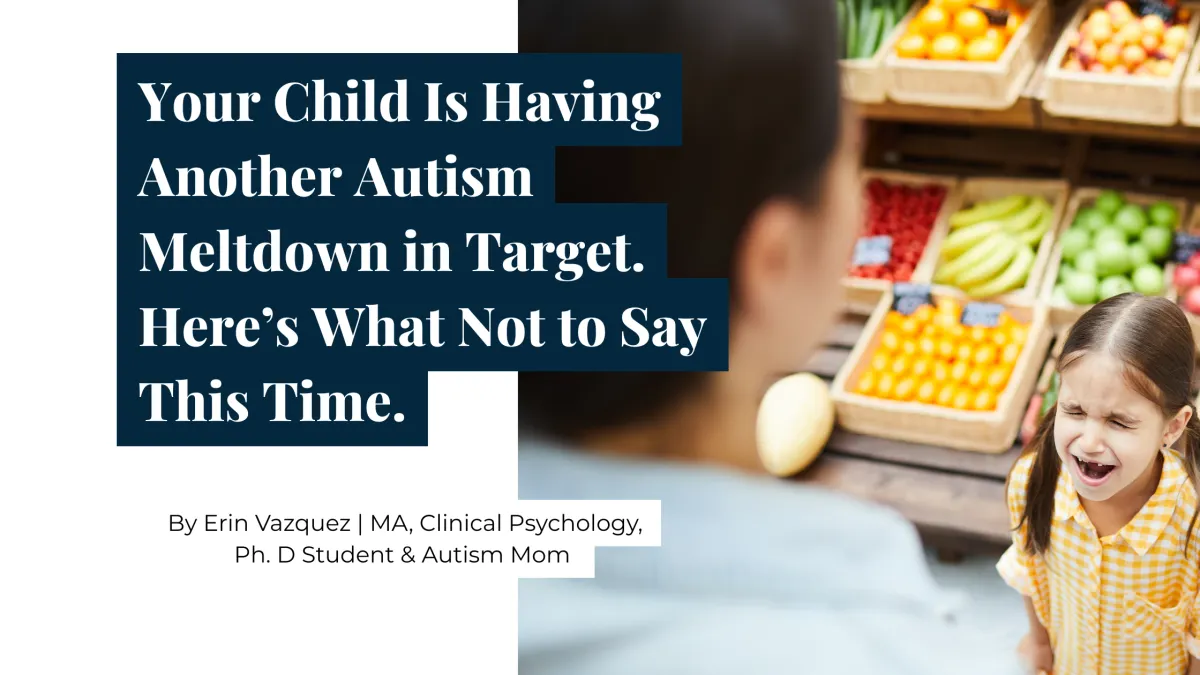
There you are in Target.
One minute you are choosing laundry detergent. The next, your child is on the floor, screaming, crying, bolting, shutting down, or completely unreachable.
Your cart is half-full. Your face is hot. Someone nearby is pretending not to stare while absolutely staring. Another person gives you the look — the one that says they have never met sensory overload in their life but still somehow feel qualified to judge your parenting.
And suddenly your brain starts searching for the sentence that will fix it.
You want to say the right thing.
You want to calm them down.
You want to prove to the people watching that you are handling it.
You want your child to know you are there.
You want the whole thing to stop because your nervous system is now also approaching DEFCON 1.
So you start talking.
You explain. You ask. You negotiate. You whisper-yell. You try logic. You offer choices. You say their name 47 times like it might magically bring the upstairs brain back online.
And here is the hard, liberating truth:
During an autism meltdown, your words usually have less power than you think.
Your presence has more.
That does not mean communication does not matter. It means the type of communication that helps changes completely.
When an autistic child is in meltdown, their nervous system is not looking for a lecture. It is looking for safety.
First: This Is Not a Tantrum
Before we talk about what not to say, we need to name what is actually happening.
An autism meltdown is not a child trying to embarrass you in aisle seven.
It is not “attention-seeking.”
It is not a negotiation tactic.
It is not your child deciding to ruin the day because you said no to a dinosaur cup.
A meltdown is a physiological overload response. The nervous system has hit capacity, and the child’s brain and body are now trying to survive.
That can look like:
crying,
screaming,
hitting,
kicking,
running,
dropping to the floor,
hiding,
freezing,
shutting down,
repeating phrases,
covering ears,
becoming unable to speak,
or seeming completely disconnected from what is happening around them.
And because the meltdown is happening in public, your nervous system is probably reacting too.
That matters.
Because the moment other people are watching, many parents shift from supporting the child to managing the audience.
Completely understandable.
Also usually unhelpful.
Your child does not need you to prove anything to the woman by the candles.
Your child needs you to become less threatening, less urgent, less verbally overwhelming, and more anchored.
Why Words Often Stop Working During a Meltdown
During a meltdown, your child’s brain is not operating the way it does when they are calm.
The parts of the brain responsible for reasoning, flexible thinking, impulse control, and language processing are much harder to access during high stress. In simple terms: the “thinking brain” gets quieter, and the survival system gets louder.
This is why your child may not be able to:
answer questions,
explain what is wrong,
use coping skills on command,
understand consequences,
follow multi-step directions,
respond to reasoning,
or “just take a deep breath” because you told them to.
It is not because they are refusing.
It is because their brain may not be available for that kind of processing.
This is the part so many people miss.
They treat a meltdown like a behavior problem when it is often a capacity problem.
And if you respond to a capacity problem with more demands, the nervous system usually escalates.
What Not to Say During an Autism Meltdown in Public
Words can help.
But the wrong words, even well-intended ones, can accidentally add pressure, shame, or sensory input when your child is already overloaded.
Here is what to avoid.
Don’t Say: “Calm Down”
This is probably the most common phrase people reach for.
It also usually does not work.
“Calm down” sounds simple to us, but to a dysregulated child it can land like a demand:
Fix your nervous system right now.
If your child could calm down on command, they probably would have done it already. Meltdowns are not fun for children. They are overwhelming, exhausting, and often frightening.
What to say instead:
“I’m here.”
“You’re safe.”
“I’m staying close.”
“We’re going to get through this.”
Or say nothing for a moment and simply lower the intensity of your presence.
The goal is not to command calm.
The goal is to communicate safety.
Don’t Ask: “What’s Wrong?”
This one makes sense from the parent side.
You are trying to understand.
But during a meltdown, questions can become demands.
To answer “What’s wrong?” your child has to:
notice what they are feeling,
identify the trigger,
find language,
organize the sentence,
respond while overwhelmed,
and tolerate your expectation for an answer.
That is a lot to ask from a nervous system already on fire.
Other questions to avoid during peak meltdown:
“Why are you doing this?”
“What do you need?”
“Are you okay?”
“Do you want to leave?”
“Can you use your words?”
“What did I tell you?”
Even gentle questions can be too much.
What to say instead:
Use statements.
“This is hard.”
“I see this is too much.”
“I’m moving the cart.”
“We’re going somewhere quieter.”
“You don’t have to answer.”
Statements reduce pressure. Questions often increase it.
Don’t Say: “Use Your Words”
I know why parents say this.
We want communication. We want the child to tell us what they need. We may have spent years encouraging language, scripts, AAC, signs, or emotional vocabulary.
But during meltdown, “use your words” can be like asking someone to solve algebra while drowning.
Language may not be online.
And if your child is semi-speaking, nonspeaking, gestalt language processing, or prone to shutdown, the demand to produce speech can add another layer of distress.
What to do instead:
Accept communication in whatever form is available.
That may be:
pointing,
moving away,
covering ears,
crying,
pushing an item away,
using a familiar phrase,
reaching for you,
avoiding touch,
hiding,
or not responding at all.
Behavior is communication, especially during overload.
You can model words later.
During the meltdown, reduce the demand to perform language.
Don’t Explain, Lecture, or Reason
This is where many of us get trapped.
We start explaining why we cannot buy the toy. Why the store is almost done. Why hitting hurts. Why leaving the cart in the middle of Target is complicated. Why we really need toilet paper and cannot abandon the mission.
The explanations may be true.
They may also be completely useless in the moment.
During a meltdown, logic is usually too expensive.
Your child’s nervous system is not looking for a persuasive argument. It is looking for less input.
Avoid saying:
“You need to understand…”
“I already told you…”
“We have to leave because…”
“You can’t act like this because…”
“If you would just listen…”
What to say instead:
Keep it short.
“Less talking now.”
“We’ll talk later.”
“First calm, then problem-solving.”
“I’m going to help keep everyone safe.”
Teaching belongs after the nervous system has returned to safety.
Not while your child is in survival mode.
Don’t Threaten Consequences
This is the moment where public pressure can hijack the parent brain.
People are watching. You feel judged. Your child is loud. You want to regain control.
So the threats come out:
“If you don’t stop, we’re leaving.”
“No iPad later.”
“You’re losing screen time.”
“I’m not taking you anywhere again.”
“One more time and you’re in big trouble.”
Here is the problem: threats add threat.
A child in survival mode does not need more fear layered on top of overwhelm.
And consequences require the very skills your child may not be able to access in the moment: reasoning, future thinking, impulse control, and cause-and-effect processing.
This does not mean there are no boundaries.
It means boundaries during meltdown need to focus on immediate safety, not punishment.
What to say instead:
“I won’t let you hit.”
“I’m moving this away.”
“I’m giving your body space.”
“We’re going to a safer spot.”
“I’m here. I’ll help.”
Safety is different from punishment.
Your child can feel that difference.
Don’t Shame or Compare
Please, for the love of nervous systems everywhere, do not bring shame into a meltdown.
Avoid:
“Everyone is staring.”
“You’re embarrassing me.”
“Your sister doesn’t act like this.”
“You’re too old for this.”
“Stop acting like a baby.”
“I can’t believe you’re doing this again.”
These phrases may come from your own panic, exhaustion, or humiliation.
But they do not regulate.
They wound.
A child in meltdown is already overwhelmed. Adding shame may quiet them eventually, but quiet is not the same as regulated. Sometimes shame just teaches a child to collapse inward instead of needing outwardly.
That is not the goal.
The goal is not a child who looks less embarrassing.
The goal is a child who feels safer in their own body and safer with you.
What to say instead:
“You’re having a hard time.”
“I’m not mad.”
“We’re going to move through this.”
“You are not in trouble for being overwhelmed.”
“I’ll help keep you safe.”
And if you are too activated to say anything supportive?
Say less.
Silence is better than shame.
Don’t Perform for the Audience
This one is not about what you say to your child. It is about what you say because other people are watching.
Public meltdowns activate a very specific kind of parent panic.
Suddenly you are not just responding to your child. You are also trying to communicate to strangers:
I am a good parent.
I have rules.
I am not ignoring this.
I promise I am trying.
Please do not judge me.
That pressure can make parents over-talk, over-correct, over-explain, or become harsher than they would be at home.
It is understandable.
And it is worth noticing.
Because your child is not the only nervous system in the aisle.
Yours is there too.
Try this internal script:
My job is not to manage strangers’ opinions. My job is to support safety.
You may still feel embarrassed. That is human.
But you do not have to let embarrassment become the driver.
What To Say During a Public Autism Meltdown
When words do help, they are usually:
brief,
concrete,
calm,
repetitive,
and low-demand.
You are not trying to win a debate. You are trying to reduce nervous system load.
Helpful phrases:
“I’m here.”
“You’re safe.”
“I’m staying with you.”
“Less talking now.”
“We’re moving to quiet.”
“I won’t let you get hurt.”
“I’ll help.”
“We’ll figure it out later.”
“You don’t have to answer.”
“First calm, then talking.”
Pick one or two phrases and repeat them gently.
Do not introduce a TED Talk.
A dysregulated brain does not need variety.
It needs predictability.
How to Use Your Voice
Your voice is one of your most powerful tools during a meltdown.
Not because the words are magical, but because tone carries safety or threat.
When you are helping an autistic child during meltdown, pay attention to:
Volume
Lower your voice. A loud voice can increase alarm.Pace
Slow down. Fast talking communicates urgency.Tone
Aim for warm and steady, not syrupy or overly animated.Repetition
Use the same phrase rather than constantly changing directions.Prosody
A softer rhythm can feel safer than clipped, sharp speech.
This does not mean fake calm.
Children can often sense when we are performing calm through clenched teeth.
It means regulate what you can.
Even a 10% softer voice can help.
Use Your Body Before Your Words
Your body may be communicating more than your mouth.
During a meltdown, think about what your posture, distance, and facial expression are saying.
Helpful non-verbal supports:
Get lower instead of towering over your child.
Step slightly back if closeness escalates them.
Keep your face neutral and steady.
Move slowly.
Reduce sudden gestures.
Block danger without grabbing unless safety requires it.
Offer your hand without forcing touch.
Create space from noise, crowds, lights, or movement.
Some children want deep pressure or physical closeness.
Some children cannot tolerate touch during meltdown.
This is where knowing your child matters more than following a universal script.
The question is not, “What would look comforting to me?”
The question is, “What actually helps my child’s nervous system feel safer?”
What To Do If People Are Staring
People will stare.
Some will be concerned. Some will be nosy. Some will be judgmental. Some will be remembering their own hard parenting moment. You will not know which is which.
If you have the capacity to say something, keep it short.
Scripts for strangers:
“He’s overwhelmed. We’re okay.”
“She needs space. Thank you.”
“This is a medical/sensory situation.”
“We’re handling it.”
“Please give us room.”
You do not owe strangers your child’s diagnosis, history, support needs, or your full parenting philosophy.
You are allowed to be brief.
You are allowed to protect your child’s privacy.
You are allowed to ignore people completely.
That last one is often underrated.
Here are ten short scripts for strangers who are staring.
What To Do After the Meltdown
After a meltdown, your child may be exhausted, embarrassed, quiet, clingy, silly, avoidant, or still tender.
This is not usually the time for a long debrief.
Recovery comes first.
After the meltdown, focus on:
Safety
Is everyone physically okay?Recovery
Does your child need quiet, food, water, movement, pressure, or sleep?Connection
Can you offer reassurance without forcing conversation?Repair
If you yelled, threatened, or shamed, come back and own it.Learning later
When everyone is regulated, you can gently look for patterns.
The best teaching usually happens after the nervous system has settled.
Not during the storm.
Not immediately after the storm.
After.
How to Learn From a Public Meltdown Without Blaming Yourself
A public meltdown can be incredibly stressful, but it can also give useful information.
Not “How did I fail?”
Better questions:
What happened before the meltdown?
Was there a sensory trigger?
Was the store too loud, bright, crowded, or unpredictable?
Was my child hungry, tired, sick, hot, or already overloaded?
Was there a transition they were not prepared for?
Did I miss earlier signs of escalation?
What helped even a little?
What made it worse?
What would I change next time?
This is not self-blame.
This is pattern recognition.
Autism parenting becomes less chaotic when patterns become visible.
A Simple Public Meltdown Plan
You do not need a perfect plan.
You need a plan simple enough to remember when your own nervous system is activated.
Try this:
The 5-Step Public Meltdown Plan
Pause
Take one slow exhale before speaking.Reduce
Lower words, demands, noise, light, attention, and movement where possible.Protect
Focus on immediate safety for your child, yourself, siblings, and nearby people.Relocate
Move to a quieter or safer space if you can do so without escalating the situation.Recover
Delay teaching, consequences, and processing until everyone’s nervous system is calmer.
That is it.
Pause. Reduce. Protect. Relocate. Recover.
Simple is not basic.
Simple is what works under stress.
Final Thoughts
When your child has an autism meltdown in public, it can feel like the whole world is watching your hardest moment.
But your child’s meltdown is not a parenting performance.
It is a nervous system event.
And helping an autistic child during meltdown is not about finding the perfect sentence that magically fixes everything.
It is about becoming less overwhelming.
Less verbal.
Less urgent.
Less focused on public opinion.
More focused on safety.
More focused on connection.
More focused on helping your child’s body move through something hard without adding shame to the experience.
You will not do it perfectly every time.
No one does.
But each meltdown can teach you something about your child’s nervous system, your own nervous system, and what support needs to look like next time.
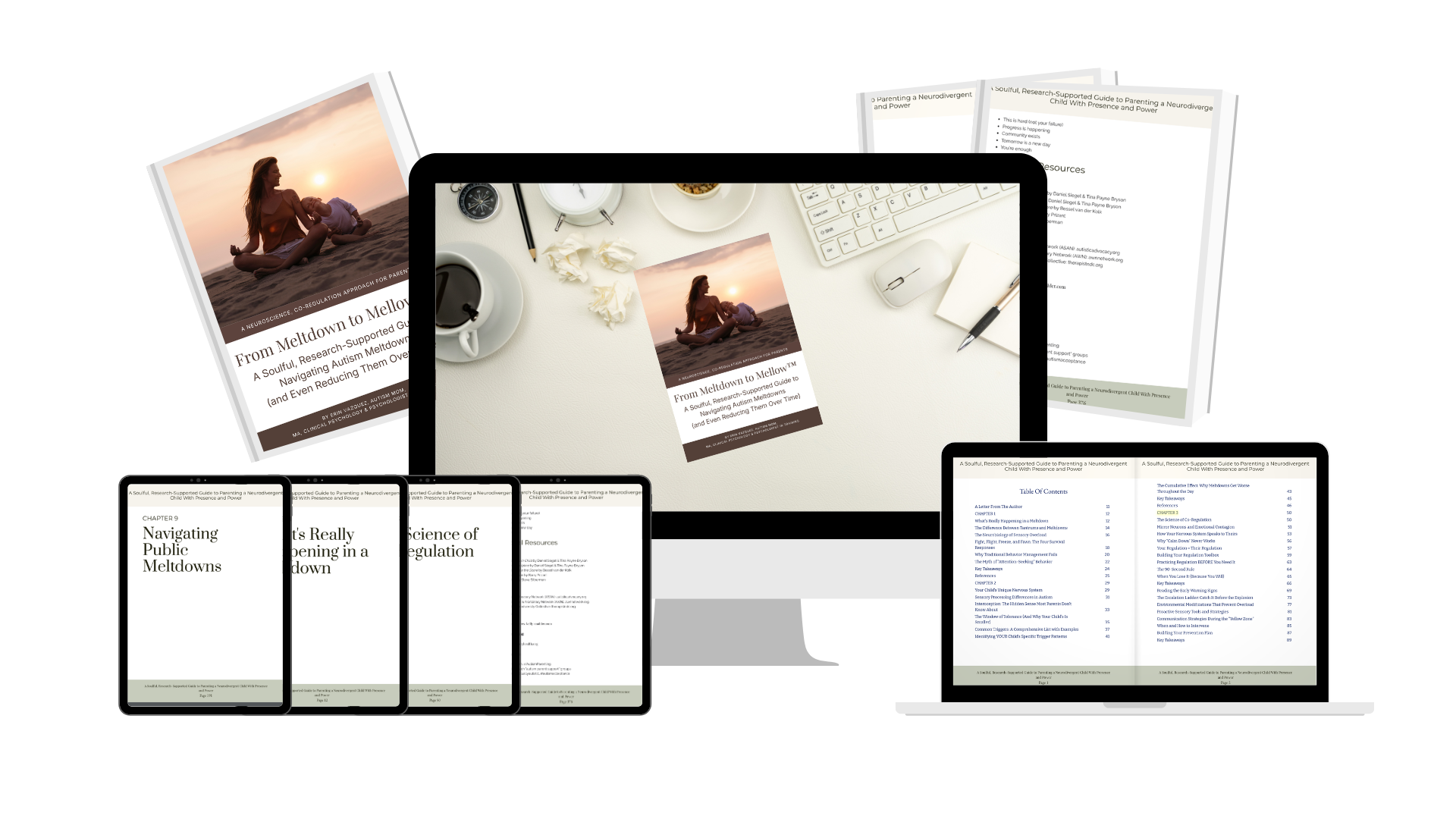
If this helped you understand public meltdowns with more clarity and less shame, you’ll find more inside From Meltdown to Mellow™, where I go deeper into meltdown neurobiology, what to say, what not to say, public meltdown support, repair, and parent regulation.
References
Arnsten, A. F. T. (2009). Stress signalling pathways that impair prefrontal cortex structure and function. Nature Reviews Neuroscience, 10(6), 410–422. https://doi.org/10.1038/nrn2648
Gottman, J. M., & Levenson, R. W. (2000). The timing of divorce: Predicting when a couple will divorce over a 14-year period. Journal of Marriage and Family, 62(3), 737–745. https://doi.org/10.1111/j.1741-3737.2000.00737.x
Gross, J. J., & Levenson, R. W. (1997). Hiding feelings: The acute effects of inhibiting negative and positive emotion. Journal of Abnormal Psychology, 106(1), 95–103. https://doi.org/10.1037/0021-843X.106.1.95
Lerman, D. C., & Vorndran, C. M. (2002). On the status of knowledge for using punishment: Implications for treating behavior disorders. Journal of Applied Behavior Analysis, 35(4), 431–464. https://doi.org/10.1901/jaba.2002.35-431
Sauter, D. A., Eisner, F., Calder, A. J., & Scott, S. K. (2010). Perceptual cues in nonverbal vocal expressions of emotion. Quarterly Journal of Experimental Psychology, 63(11), 2251–2272. https://doi.org/10.1080/17470211003721642
Tangney, J. P., Stuewig, J., & Mashek, D. J. (2007). Moral emotions and moral behavior. Annual Review of Psychology, 58, 345–372. https://doi.org/10.1146/annurev.psych.56.091103.070145
Vazquez, E. (n.d.). From Meltdown to Mellow™: A science-backed guide for using connection to navigate, and even reduce, autism meltdowns starting with the next one [PDF guide].