Calming Environment for an Autistic Child in Public
You cannot turn down the lights in an entire grocery store.
You cannot silence every hand dryer, move every crowd, stop the music in a restaurant, or control whether someone decides to stare.
That lack of control can make public outings feel impossible, especially when you see your child becoming overwhelmed and know the environment is pushing their nervous system closer to its limit.
But you do not need to control the entire building to make a meaningful difference.
You can create a smaller, temporary environment around your child—a regulation bubble—by changing where you stand, what your child can see and hear, how much is being asked of them, and how much social pressure reaches them.
Direct answer: How do you create a calming environment for an autistic child in public?
To create a calmer public environment for an autistic child, move away from crowds and noise, reduce visual input, offer hearing or light protection, lower verbal and social demands, identify a quiet space, provide familiar sensory supports, and keep an exit route available.
You May Not Control the Building, but You Can Change the Immediate Environment
Public spaces can create a complicated mix of sounds, movement, smells, touch, unpredictability, and social expectations. Research suggests sensory environments can become significant barriers to autistic people’s participation in public life, especially when the person has little control over the intensity or duration of the input.
Your goal is not to make the entire environment perfect.
Your goal is to reduce the amount of information your child’s nervous system must process right now.
Think smaller:
One quieter corner
One protected seat
One pair of headphones
One familiar object
One adult who stops talking and stays close
That can be enough to help your child regain some capacity.
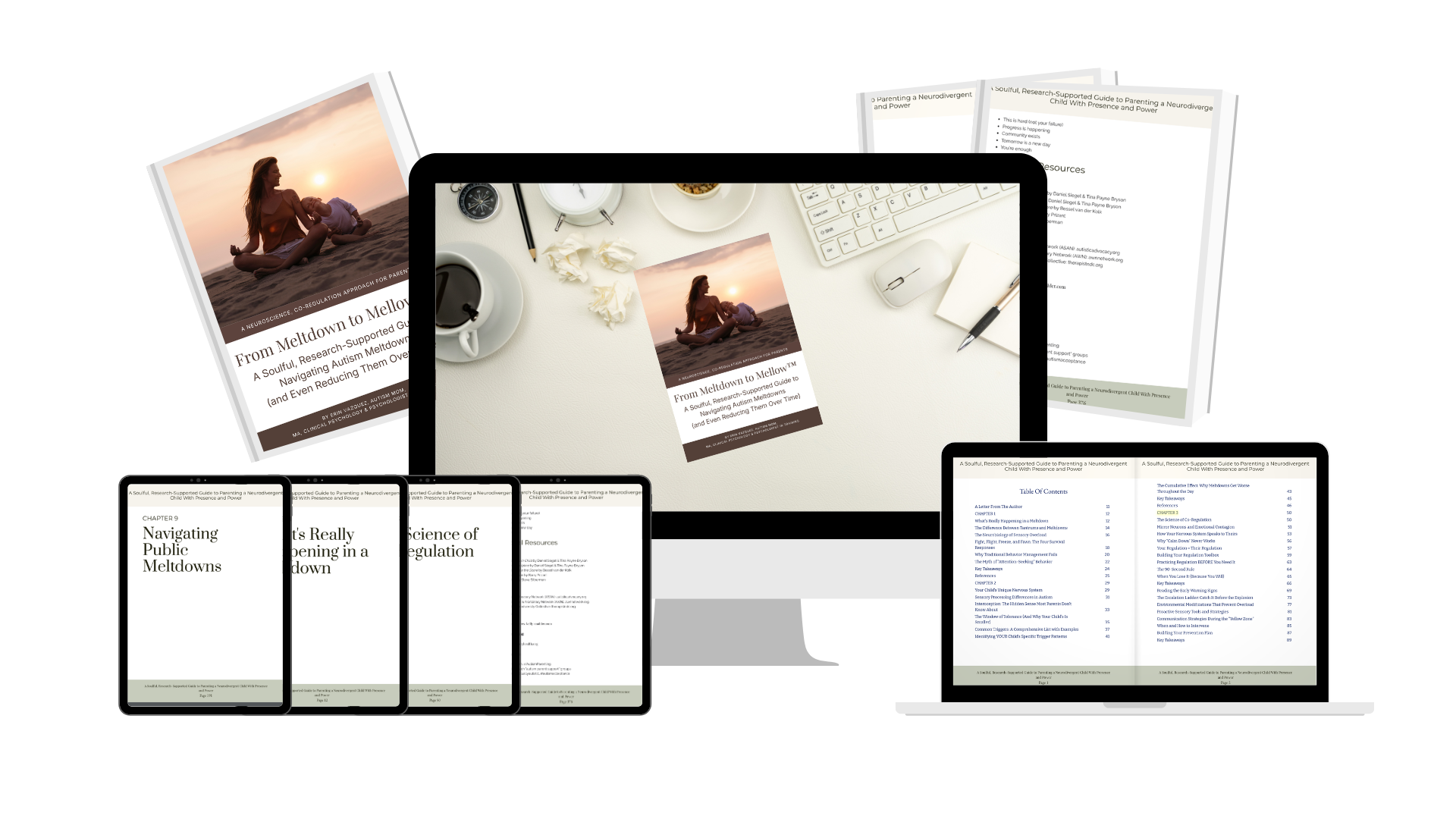
This approach reflects the environmental assessment used in From Meltdown to Mellow™: look beyond visible behavior and consider auditory, visual, tactile, olfactory, proprioceptive, vestibular, cognitive, and social demands.
Reduce the Five Biggest Sources of Public Overload
Noise
Public noise is rarely one sound. It is dishes clattering, children crying, carts rattling, music playing, people talking, announcements blaring, and hand dryers erupting without warning.
To reduce sensory overload in public:
Sit away from speakers, kitchens, bathrooms, and high-traffic areas.
Offer noise-reducing headphones or ear protection.
Step outside during announcements, live music, or especially noisy transitions.
Use fewer words yourself so your voice does not become one more demand.
Do not wait until your child is visibly distressed to offer hearing protection. Early support can preserve capacity.
Light and Visual Movement
Bright lighting, flashing screens, moving crowds, colorful displays, and constant peripheral movement can make it difficult for the brain to settle.
Try:
Sunglasses, a visor, or a hat
A wall-facing seat
A corner booth instead of a central table
Positioning your body between your child and the crowd
Moving away from televisions, flashing displays, or busy walkways
Environmental design research and autistic first-person accounts both emphasize the importance of reducing unwanted sensory intensity and increasing control over what enters the person’s awareness.
Smell and Temperature
Cooking smells, perfume, cleaning products, air fresheners, heat, cold, or damp clothing can quietly fill the stress bucket.
You might:
Choose a seat near fresh air.
Move away from heavily scented customers or displays.
Bring an extra layer or a lightweight change of clothes.
Leave an area where cooking or chemical smells are intense.
Offer a familiar, preferred scent when that is regulating for your child.
A trigger does not have to look dramatic to be painful. Sensory distress is still real when nobody else notices it.
Touch and Crowding
A child who can tolerate a busy environment for several minutes may lose that capacity when someone brushes against them, grabs their hand, or blocks their exit.
Create more physical safety by:
Choosing edge seating
Waiting outside instead of standing in a packed line
Keeping carts, chairs, or your body between your child and foot traffic
Asking others to step back
Not requiring hugs, handshakes, or physical greetings
A calm space for an autistic child does not always need four walls. Sometimes it is simply enough protected personal space to stop bracing.
Cognitive and Social Demands
Public overload is not only sensory.
Questions, instructions, choices, greetings, corrections, explanations, and pressure to appear socially appropriate all require processing.
As your child becomes overwhelmed:
Use fewer words.
Offer no more than one or two choices.
Stop asking them to explain what is wrong.
Remove expectations to greet, answer, apologize, or make eye contact.
Pause nonessential instructions.
Social and sensory environments can both increase stress for autistic people, particularly when expectations are unpredictable or difficult to escape.
Find the Quietest Available Space
You do not need an official sensory room. Look for the least demanding space available:
Outdoor seating
A vestibule
An empty hallway
A customer service area
A family restroom, when appropriate
A corner booth
A shaded area outside
Your car
Use this script:
“My child is experiencing sensory overload. Is there a quieter place we can use for a few minutes?”
Many parents hesitate to ask because they do not want to inconvenience anyone.
Ask anyway.
A quieter space is an accommodation, not a reward your child must earn by holding it together longer.
Use Your Body and Presence as Part of the Environment
Your body becomes part of your child’s immediate surroundings.
You can lower the intensity by:
Standing between your child and onlookers
Softening your face and voice
Reducing unnecessary movement
Remaining nearby without hovering
Asking other people to give space
Turning your attention away from the audience and back toward your child
In public, your own shame response may make you move faster, talk more, or try harder to make the situation stop.
That urgency is understandable. It can also add more intensity.
Let the world shrink temporarily. Your child does not need you to manage everyone’s opinion. They need you to help reduce what reaches their nervous system.
Lower Demands Before Adding More Tools
Sometimes the most effective environmental modification for autism is not another fidget, weighted item, snack, or sensory gadget.
It is stopping.
Stop asking questions.
Stop correcting.
Stop explaining.
Stop negotiating.
Stop insisting that your child say what they need.
During significant overload, additional cognitive demands can prolong the crisis. The CALM Response System in From Meltdown to Mellow™ pairs environmental assessment with an immediate lowering of demands because a depleted nervous system cannot process its way back to safety through more instructions.
When the Environment Cannot Be Made Safe Enough
Leave.
You do not have to prove that your child can endure an environment that is hurting them.
Leaving during nervous-system overload is not “giving in.” It is recognizing that the current environment exceeds your child’s available capacity.
Exposure should not require enduring crisis.
Skill-building happens when a child has enough support and regulation to participate—not when they are already drowning in sensory and social input. Research on sensory-friendly zones also supports providing autistic children and families with spaces where they can retreat, recover, and participate on more manageable terms.
Examples by Setting
Grocery store
Move to the edge of the store, leave the cart if necessary, offer headphones, reduce conversation, and use the car for a reset.
Restaurant
For a more sensory-friendly restaurant experience with autism, request a corner booth, sit away from the kitchen and speakers, avoid peak hours, and ask for food to be packaged if the environment becomes too much.
Birthday party
Find a bedroom, porch, yard, hallway, or quiet corner. Remove expectations to participate in every activity, greeting, photograph, or group ritual.
Doctor’s office
Ask to wait outside or in the car. Request a quieter room, dimmed lights, minimal staff movement, and fewer verbal instructions.
School event
Sit near an exit. Identify a quiet space before the event begins. Let your child step out without making their return the immediate goal.
The outing does not have to look typical to be meaningful.
Success may mean staying for twenty minutes instead of two hours. It may mean eating in the car. It may mean leaving before the meltdown instead of after it.
That is not failure.
That is you recognizing what your child’s nervous system is telling you—and responding before they have to scream it louder.
In-The-Moment Autism Outing Planning Help
As an autism parent, you have a lot on your plate. Sometimes planning for an outing feels overwhelming, or you just may not have the bandwidth.
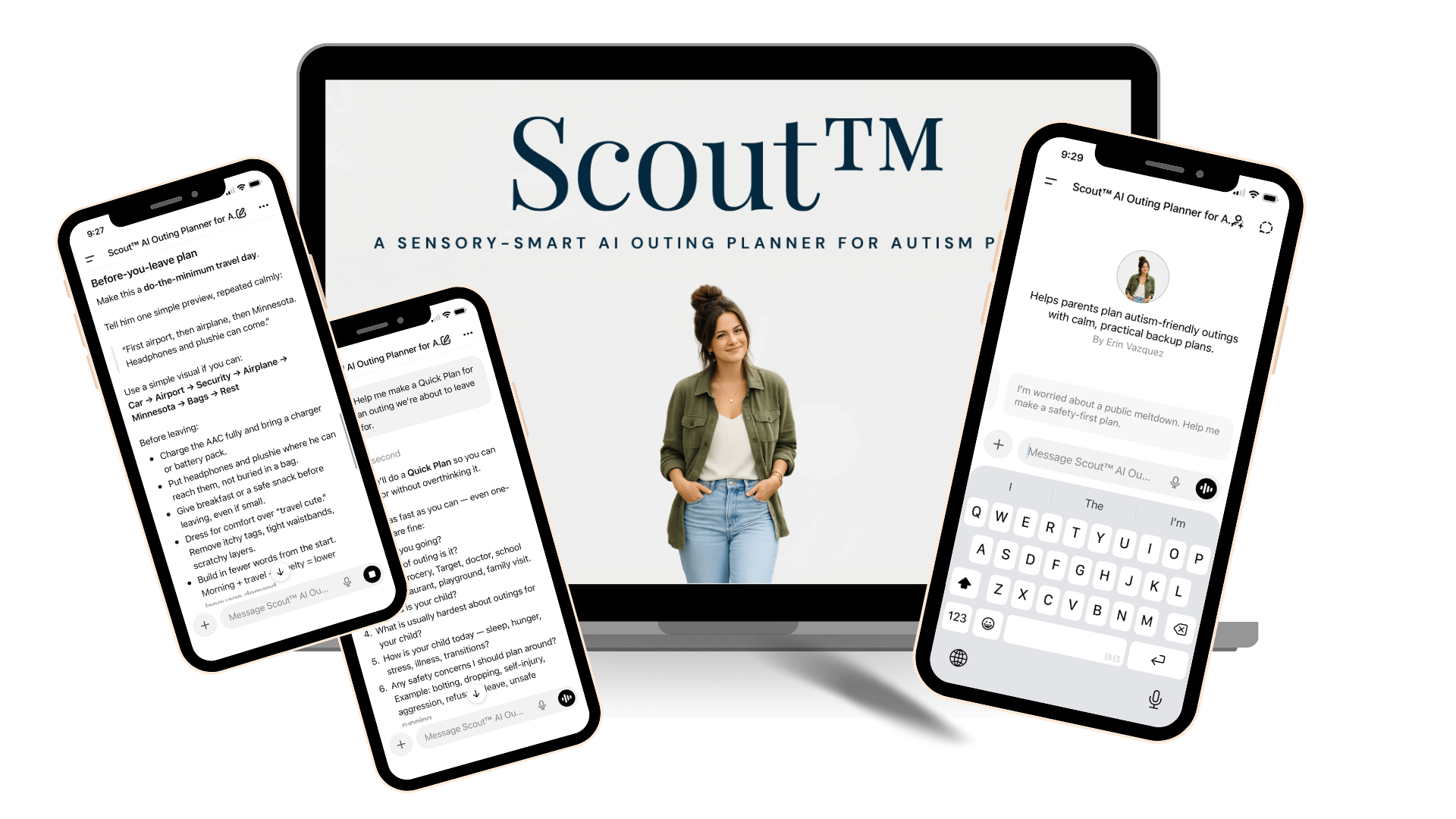
That's why I created Scout™, an AI assistant for autism parents that gives customized recommendations for anythign from a grocery run to doctor's appointment to cross-country plane trip. Just tell Scout™ where you're going, how your child is feeling that day (hunger, sleep, any other factors for concern) and get a comprehensive list of what to bring, what to say, what to look out for, when to go should things get escalated, and so much more.
If you need extra support, you can learn more here.
References
Clément, M. A., Lee, K., Park, M., Sinn, A., & Miyake, N. (2022). The need for sensory-friendly “zones”: Learning from youth on the autism spectrum, their families, and autistic mentors using a participatory approach. Frontiers in Psychology, 13, 883331. https://doi.org/10.3389/fpsyg.2022.883331
MacLennan, K., O’Brien, S., & Tavassoli, T. (2022). In our own words: The complex sensory experiences of autistic adults. Journal of Autism and Developmental Disorders, 52, 3061–3075. https://doi.org/10.1007/s10803-021-05186-3
National Autistic Society. (n.d.). Accessible environments.
National Autistic Society. (n.d.). Autism and sensory processing.
Unwin, K. L., Powell, G., & Jones, C. R. G. (2022). The use of multi-sensory environments with autistic children: Exploring the effect of having control of sensory changes. Autism, 26(6), 1379–1394. https://doi.org/10.1177/13623613211050176