Communication Techniques for Autistic Children on Outings
You are standing in the middle of a store, watching your child’s distress build.
The lights are too bright. Someone is talking over the loudspeaker. A cart rattles past. Your child covers their ears, drops to the floor, or stops responding.
And because people are watching, your own nervous system starts shouting, Do something. Say something. Fix this.
So you talk faster. You repeat yourself. You explain why you have to finish shopping. You ask what is wrong.
But the more overwhelmed your child becomes, the less language may help.
This does not mean you communicated badly or caused the meltdown. It means your child’s communication capacity changed under stress, and your communication needs to change with it.
Direct answer: During a stressful public outing, use fewer words, speak slowly and concretely, offer one direction at a time, reduce questions, allow extra processing time, use visual or nonverbal supports, and stop requiring explanations once your child becomes overwhelmed. Keep reading for more communication strategies to prevent public autism meltdowns.
Communication Capacity Changes Under Stress
An autistic child who can speak, negotiate, and answer questions while regulated may temporarily lose access to those abilities during sensory overload.
Acute stress can interfere with working memory, cognitive flexibility, inhibition, and other prefrontal functions needed to process instructions and formulate a response (Arnsten, 2009; Shields et al., 2016).
Your child may hear your words without being able to organize them. They may understand but be unable to answer. They may communicate through movement, gestures, AAC, repetition, silence, or attempts to escape.
That is not defiance.
During a meltdown, the goal is no longer to get an explanation or teach a lesson. The goal is to lower demands, protect safety, and communicate, “You do not have to perform for me. I am here.”
Technique 1: Use Fewer Words
When processing capacity decreases, every additional sentence can become another demand.
Instead of:
“We already talked about this. You need to stop yelling, put your shoes on, and come with me right now.”
Try:
“Shoes on.”
“Then car.”
“I’m here.”
This is the heart of using minimal language for autism communication during overload: one idea, a few words, and time to process them.
Your tone matters too. Speak more slowly and quietly than your fear is telling you to. A phrase that sounds supportive when spoken gently can feel threatening when delivered rapidly through clenched teeth.
Technique 2: Make Language Concrete
During overload, avoid language your child has to interpret.
That includes:
Vague reassurance such as “Everything is fine”
Idioms, sarcasm, or rhetorical questions
Long explanations
“Maybe” when the boundary is firm
Several instructions packed into one sentence
Say what is happening now and what will happen next:
“The store is loud.”
“We are going outside.”
“First bathroom, then car.”
“You can walk or ride in the cart.”
Choices can restore a small amount of agency, but only when both options are truly available. Two manageable choices are usually enough. Six choices can become six more things to process.
Technique 3: Offer Processing Time
Say the instruction once, then pause.
When your child does not answer immediately, your instinct may be to repeat it louder:
“Shoes on. Shoes on. I said shoes on. Did you hear me?”
But repetition does not always make language easier to process. It may simply add more sound to an already overloaded system.
Give your child several quiet seconds. Watch for nonverbal signs that they are responding: looking toward the exit, reaching for headphones, shifting their body, pointing, or opening their AAC device.
Silence is not the absence of support. Sometimes it is the accommodation.
Technique 4: Use Visual and Nonverbal Communication
Communication does not have to be spoken.
Visual activity schedules have research support for autistic people, particularly when paired with thoughtful, individualized instruction (Knight et al., 2015). Visual supports may also provide a concrete reference that remains available after spoken words disappear.
Useful public-outing supports include:
A first-then card
A break card
An “I need help” card
A visual timer
A picture schedule
Pointing toward the exit
A familiar gesture
Texting with an older child
AAC access at all times
AAC is not something to remove because a child can sometimes speak. It can support communication when speech is unavailable or unreliable, and research reviews have found positive communication outcomes from AAC interventions for autistic children.
Technique 5: Match Communication to the Escalation Stage
When Your Child Is Regulated
This is the time to preview the outing, practice scripts, discuss possible changes, and ask what kind of help your child prefers.
You might say:
“If it gets too loud, how will you tell me?”
“Would you rather use your break card or tap my hand?”
“Where should we go if you need quiet?”
During Early Overload
Reduce language before your child reaches crisis. Name what you observe without demanding an explanation.
“I see you covering your ears.”
“Headphones or outside?”
“We can pause.”
During a Meltdown
Prioritize safety. Stop asking “why.” Do not reason, lecture, threaten, or require eye contact.
Use brief reassurance only if your child finds it helpful:
“We’re okay. I’ve got you.”
“Let’s find somewhere quiet.”
“No talking needed.”
To people approaching:
“We need space, please.”
The communication guidance in From Meltdown to Mellow™ emphasizes that during crisis, tone, pace, facial expression, and nonverbal presence can matter more than a lengthy explanation. It recommends minimal words centered on safety and connection, not performance.
During Recovery
Offer water, food, quiet, or rest. Do not demand an immediate debrief.
Wait for signs that language is returning, such as your child initiating, responding more easily, relaxing physically, or reaching toward you.
Then ask:
“Do you want to talk later, or have more quiet?”
Recovery is not the moment to prove that the meltdown “wasn’t necessary.” It is the moment to help your child’s body feel safe again.
What Not to Say During Public Overload
Avoid phrases that increase demand, shame, or sensory load:
“Calm down.” This asks your child to produce the very state they cannot currently access.
“Use your words.” Speech may be temporarily unavailable. Accept gestures, AAC, movement, or silence.
“Everyone is looking at you” or “You’re embarrassing me.” These add social shame to neurological distress.
“There is nothing wrong.” Something feels wrong in your child’s body, even when you cannot see the source.
“Stop acting like this.” A meltdown is not a performance your child can simply end.
“Tell me why you’re doing this.” Explanation requires language, reflection, and executive functioning that may be offline.
“We are not leaving until you behave.” This can trap your child in the environment that is overwhelming them.
Autism Public-Outing Scripts for Common Situations
Leaving a store
“We’re going outside now.”
“You’re safe.”
“No talking needed.”
Waiting at a restaurant
“Food is taking longer.”
“Timer or car break?”
Responding to staff
“My child is experiencing sensory overload. We need a few minutes and some space.”
Responding to strangers
“Thank you, we’re handling it.”
“We need space, please.”
Supporting a child who is shutting down
“I’m right here.”
“Take your time.”
“No rush.”
You do not owe the room a convincing explanation. Your attention belongs with your child.
Teach Public-Outing Communication During Calm Times
Practice communication before it is urgently needed.
Role-play requesting a break. Help your child identify safe adults. Practice “I need space.” Create a separation or elopement safety plan. Let your child help select the words, images, gestures, or AAC messages they want you to use.
The nervous system guide for autism parents called From Meltdown to Mellow™ similarly recommends practicing public safety plans, visual cards, safe-person identification, and simple scripts while the child is regulated, not attempting to introduce them for the first time during crisis.
These strategies can reduce avoidable communication pressure. They cannot guarantee that every outing will go smoothly.
A meltdown can still happen in a prepared, responsive, deeply loving family.
It does not mean you missed every sign. It does not mean your child failed to use the plan. And it does not mean you should have found better words.
Sometimes a nervous system reaches its limit.
Your job is not to deliver the perfect script. It is to stay oriented enough to recognize when words are helping—and when your child needs you to stop talking and simply help them get somewhere safer.
For the broader prevention framework, read What Strategies Help Prevent Meltdowns During Public Outings for My Autistic Child?
Deeper Parent Support for Autism Meltdowns
When you start to understand what your child's nervous system is communicating through meltdown behaviors, your experience of before, during and after the meltdown shifts.
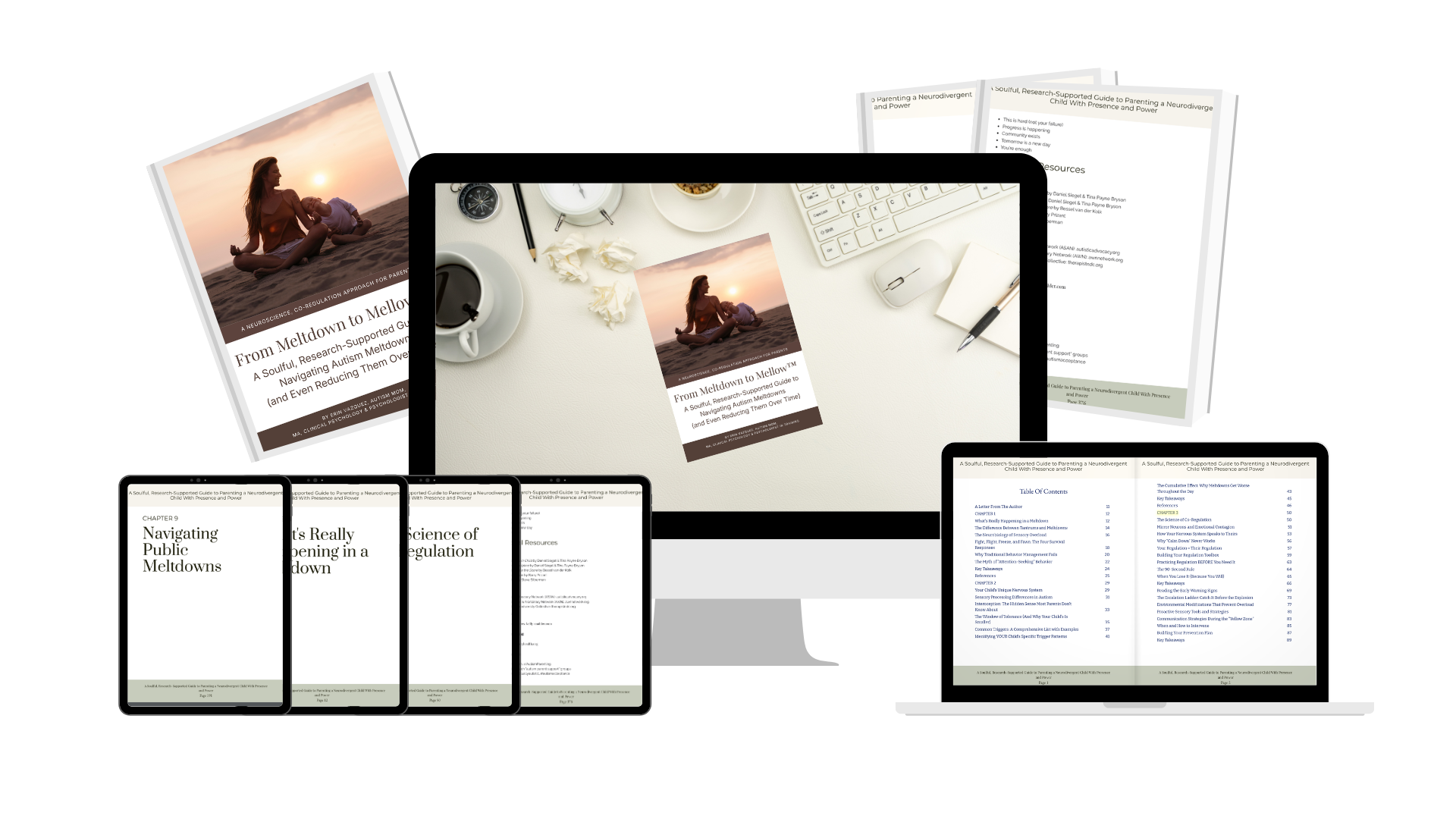
That's why I created a guide called From Meltdown to Mellow™ offers a deeper, step-by-step guide to recognizing triggers, reducing sensory load, communicating during crisis, navigating public meltdowns, repairing after hard moments, and protecting your own nervous system in the process.
Learn more about From Meltdown to Mellow™.
References
Arnsten, A. F. T. (2009). Stress signalling pathways that impair prefrontal cortex structure and function. Nature Reviews Neuroscience, 10(6), 410–422. doi:10.1038/nrn2648
Knight, V., Sartini, E., & Spriggs, A. D. (2015). Evaluating visual activity schedules as evidence-based practice for individuals with autism spectrum disorders. Journal of Autism and Developmental Disorders, 45, 157–178. doi:10.1007/s10803-014-2201-z
Logan, K., Iacono, T., & Trembath, D. (2017). A systematic review of research into aided AAC to increase social-communication functions in children with autism spectrum disorder. Augmentative and Alternative Communication, 33(1), 51–64. doi:10.1080/07434618.2016.1267795
Shields, G. S., Sazma, M. A., & Yonelinas, A. P. (2016). The effects of acute stress on core executive functions: A meta-analysis and comparison with cortisol. Neuroscience & Biobehavioral Reviews, 68, 651–668. doi:10.1016/j.neubiorev.2016.06.038
White, E. N., Ayres, K. M., Snyder, S. K., Cagliani, R. R., & Ledford, J. R. (2021). Augmentative and alternative communication and speech production for individuals with ASD: A systematic review. Journal of Autism and Developmental Disorders, 51, 4199–4212. doi:10.1007/s10803-020-04868-2