Planning Public Outings for Autistic Children: 8 Essential Tips
Planning public outings for autistic children can feel like preparing for every possible emergency while trying to act as though you are simply going to the grocery store.
You pack the headphones. You bring snacks. You rehearse what might happen. And still, part of your body braces for the possibility that the lights will be too bright, the line will be too long, or one unexpected change will push your child past their limit.
A good outing plan cannot guarantee that a meltdown will not happen. That is not the goal.
The goal is to replace guesswork with preparation and to make sure you have options when your child’s nervous system says, “This is too much.”
How Do You Plan a Public Outing With an Autistic Child?
To plan a more manageable public outing with an autistic child, assess your child’s current capacity, preview the location, explain what will happen, reduce waiting and unnecessary demands, pack individualized supports, schedule breaks, and decide in advance when and how you will leave.
Predictability can help autistic children understand what is coming, while visual supports may reduce anxiety, support communication, and improve participation. However, no single tool works for every child. Your plan should be individualized and flexible rather than built around forcing the outing to continue.
Start With Capacity, Not the Calendar
The event may be on the calendar, but your child’s capacity is not fixed.
Before leaving, ask:
How did they sleep?
Have they eaten and had enough to drink?
Are they recovering from school, therapy, travel, or another demanding activity?
Are they sick, constipated, injured, or in pain?
Are they unusually anxious or sensitive today?
How many demands and transitions have already happened?
A child who tolerated a busy restaurant last Saturday may not be able to tolerate it today. That does not mean they are being inconsistent. It means their available nervous-system capacity has changed.
Changing the plan is not failure. Sometimes the most supportive public outing plan for autism is postponing, shortening, or simplifying the outing before overload begins.
Choose the Lowest-Demand Version of the Outing
You do not have to choose between staying home forever and completing the hardest possible version of an activity.
Look for the lowest-demand version:
Visit during a quieter hour.
Choose the first appointment of the day.
Use outdoor or corner seating.
Pick up an order rather than browsing.
Visit one store instead of three.
Try a familiar location before an unfamiliar one.
Plan a 20-minute visit instead of an open-ended afternoon.
Park where you can leave quickly.
Environmental changes are not “giving in.” They are legitimate accommodations. Sensory differences, unexpected changes, anxiety, crowds, noise, and communication demands can all contribute to overload. Reducing those demands can make participation more accessible.
For more location-specific ideas, internally link here to your article on [sensory strategies for autistic children in public places].
Preview the Experience
When you prepare an autistic child for a public outing, explain the experience in concrete terms.
Depending on your child’s communication preferences, you might show:
A photo of the entrance
The route or parking area
Pictures of the people who will be there
A simple visual schedule for the outing
Where the bathroom or quiet area is
What might be loud, crowded, delayed, or unfamiliar
What your child can do when they need a break
What will happen immediately afterward
Many autistic people find it helpful to know details such as the order of events, who will attend, when food will be available, and when they can leave. Previewing a location or practicing a journey in advance may also make change easier to process.
A visual schedule for outings might be as simple as:
Car → Store → Choose two items → Pay → Car → Home
It does not need to be elaborate to be useful.
Use Predictability Without Making Promises You Cannot Keep
Predictability helps. False certainty does not.
Try language such as:
“We plan to stay for about 30 minutes.”
“The restaurant may be noisy.”
“First we order, then we wait, then we eat.”
“You may use your headphones whenever you need them.”
“We can take a break in the car.”
“The plan may change, and I will tell you if it does.”
Avoid promises such as “It will be fine” or “Nothing bad will happen.” You cannot control every delay, noise, crowd, or menu change.
Honest preparation builds more trust than reassurance you may not be able to keep.
Prepare for Waiting and Transitions
Waiting combines uncertainty, delayed access, sensory exposure, and the demand to remain in one place. That can be a significant load.
Useful autism transition strategies include:
A visual timer
A countdown before leaving
One-step instructions
A familiar transition object
A preferred activity for waiting
A snack before hunger adds another stressor
A warning at ten minutes, five minutes, and one minute
A clear “finished” cue
Clear timetables, countdown timers, familiar objects, short communication, and visual supports may help autistic people navigate transitions.
For more support, internally link to [communication techniques to use before and during an autistic meltdown].
Decide the Non-Negotiables—and Release the Rest
Before leaving, decide what is truly required for safety.
Possible non-negotiables include:
Staying near the caregiver
Holding hands near traffic when necessary
Remaining physically safe
Following an essential medical or venue safety rule
Flexible expectations may include:
Making eye contact
Sitting perfectly still
Greeting every relative
Trying a new food
Staying for the entire event
Participating in the same way as other children
Hiding harmless stimming
When everything becomes a demand, your child has no room left to regulate.
Create a Written Exit Plan
Do not wait until everyone is overwhelmed to decide how to leave.
Write down:
Who takes your child outside
Who stays with siblings
Where the car is parked
Which food, purchases, or plans can be abandoned
What you will say to staff or relatives
Which signs mean the outing is officially over
What your child needs during the ride home
Your script can be simple:
“We need to leave now. Thank you for understanding.”
You do not owe strangers a complete explanation.
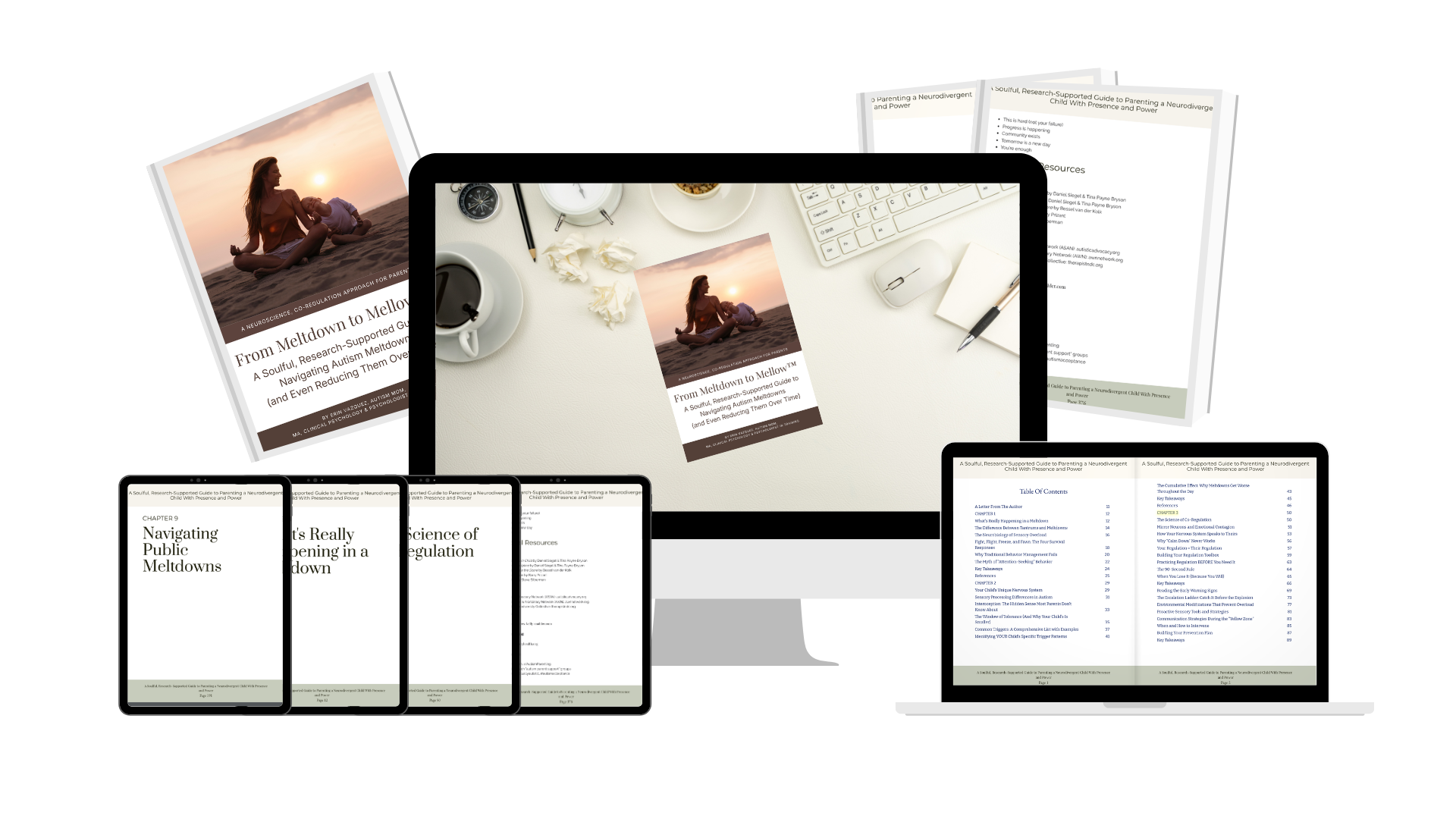
From Meltdown to Mellow™ includes setting-specific public-outing adaptations, early warning signs, safety planning, sensory tools, and car-based exit strategies so parents are not forced to invent a response in the middle of a crisis.
Use a Before-During-After Autism Outing Checklist
Before
Check sleep, food, pain, illness, and current capacity.
Preview the location and sequence.
Choose the lowest-demand version.
Pack communication and sensory supports.
Explain the exit plan.
Decide what expectations can remain flexible.
During
Watch for early signs of overload.
Reduce language and demands when stress rises.
Offer breaks before your child reaches crisis.
Use countdowns for transitions.
Provide food, water, movement, or sensory support.
Leave when the agreed exit signs appear.
After
Allow decompression before asking questions.
Avoid punishment for overload.
Notice what helped.
Record possible triggers.
Adjust the next outing plan.
Repair gently if the experience was hard.
Measure Success Differently
A successful outing with an autistic child does not have to look seamless.
Success may mean:
Your child communicated a need.
You noticed overload earlier.
You left without punishment or shame.
Recovery was faster.
You learned one useful trigger.
Your child used a support tool.
Your child felt safe enough to try again.
The win is not making your family look effortless in public.
The win is building enough safety, trust, and preparation that public life becomes more accessible—one outing at a time.
Planning Checklists for Autism Outings - Personalized in Seconds
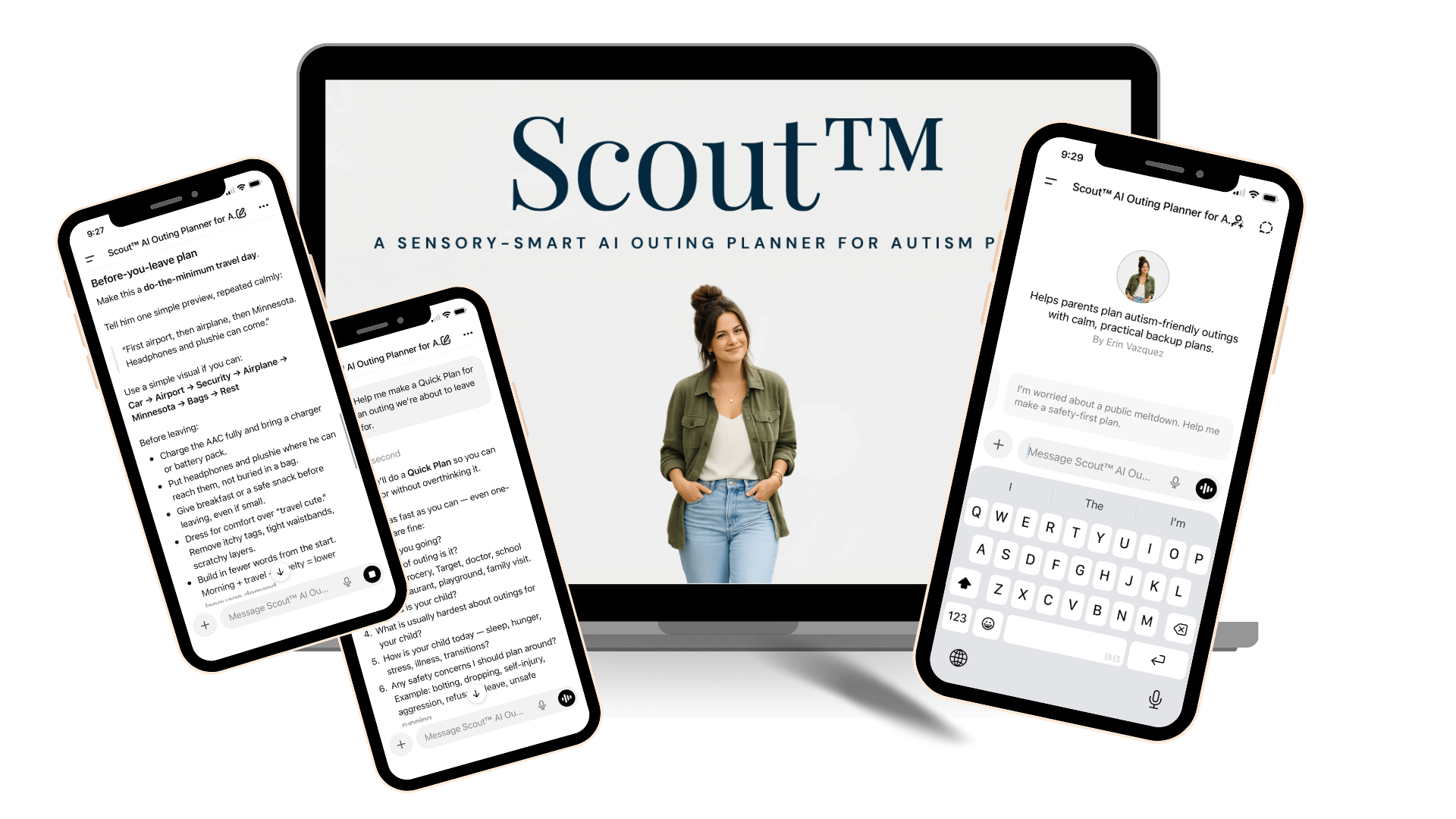
The hardest part of an outing often happens before you leave: the guessing, packing, planning, and bracing for everything that could go wrong. That's why I created Scout™. She's an AI autism parent assistant that creates a personalized, sensory-aware plan for the specific outing in front of you, including likely stress points, what to bring, early signs to watch for, and what to do if overload begins.
References
Knight, V., Sartini, E., & Spriggs, A. D. (2015). Evaluating visual activity schedules as evidence-based practice for individuals with autism spectrum disorders. Journal of Autism and Developmental Disorders, 45(1), 157–178. doi:10.1007/s10803-014-2201-z.
National Autistic Society. (2020). Meltdowns: A guide for all audiences.
National Autistic Society. (n.d.). Preference for order, predictability or routine.
Rutherford, M., Baxter, J., Grayson, Z., Johnston, L., & O’Hare, A. (2020). Visual supports at home and in the community for individuals with autism spectrum disorders: A scoping review. Autism, 24(2), 447–469. doi:10.1177/1362361319871756.