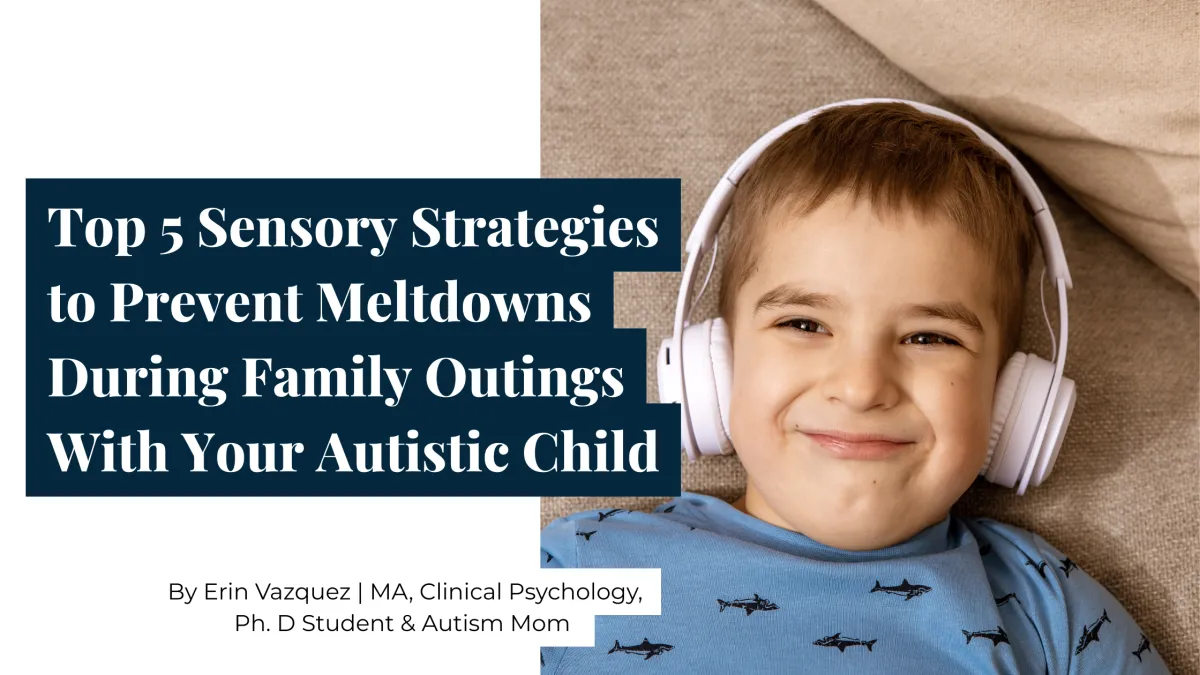
5 Sensory Strategies to Prevent Meltdowns on Outings
You know the calculation that happens before a family outing.
How loud will it be? How long will we have to wait? Will there be fluorescent lights, unfamiliar smells, scratchy wristbands, crowded hallways, or a hand dryer that sounds like a jet engine?
And underneath all that planning is the question you may not say out loud:
What can I bring or change so my child does not become completely overwhelmed?
Sensory preparation cannot guarantee that a meltdown will not happen. A meltdown is not proof that you failed, missed a warning sign, or packed the wrong tool.
But the right accommodations can reduce avoidable sensory load and give your child more ways to communicate, recover, and participate without being forced past their limits.
Five Sensory Strategies to Prevent Meltdowns
Five sensory strategies that may reduce meltdown risk during family outings are using hearing protection, reducing visual input, providing familiar tactile or proprioceptive support, scheduling movement and quiet breaks, and carrying a personalized sensory kit with food, water, comfort items, and communication supports.
The important word is personalized. Sensory differences affect everyday participation, but autistic children do not all need the same type or amount of input. A tool that organizes one child’s nervous system may irritate or overwhelm another child’s.
Sensory Support Works Best Before Overload Peaks
Sensory strategies tend to be most useful before your child reaches full nervous-system overload.
You may notice earlier signs such as:
Covering their ears
Repeating the same question
Moving faster or becoming unusually still
Pulling at clothing
Clinging to you
Losing flexibility
Trying to leave
Becoming less able to communicate
That is the time to lower demands, offer a break, or change the environment.
Do not wait until distress is at its highest and then assume your child should be able to use a new tool. Familiar supports are easier to access when they have been introduced during calmer moments.
Research on sensory intervention is mixed across specific products and techniques. Current reviews support individualized, goal-based occupational therapy approaches more strongly than the idea that one stand-alone sensory item will work for every autistic child.
Strategy 1: Protect Against Unpredictable Noise
Public spaces are full of sound you cannot control: announcements, music, clattering dishes, screaming children, hand dryers, traffic, applause, and speakers that suddenly become much louder.
Try offering:
Noise-reducing headphones
Ear defenders
Earplugs for an older child who can use them safely
Seating away from speakers, kitchens, entrances, or restrooms
Advance warnings before predictable loud sounds
A quieter arrival time before crowds build
Hearing protection should remain an option, not a demand. Let your child remove it when they choose. Some children want protection only during specific sounds, while others feel more regulated wearing it for most of the outing.
The goal is not to make your child tolerate as much noise as possible. The goal is to reduce unnecessary strain so they can use their energy for participation, communication, and connection.
Strategy 2: Reduce Brightness and Visual Chaos
Sensory overload is not always caused by sound. Bright lights, flashing displays, moving crowds, colorful shelves, unfamiliar faces, and constant activity can become exhausting.
You can reduce visual input by using:
Sunglasses
A hat, hood, or visor
Corner or booth seating
A seat facing away from crowds
Smaller, less visually cluttered locations
Off-peak visiting hours
Your body as a temporary visual barrier
During early distress, you might kneel or sit between your child and the crowd without trapping them. This can reduce the amount of movement their brain must process.
Environmental adaptations matter because sensory surroundings can influence stress, access, attention, and participation for autistic people. Studies of adapted environments suggest that lowering sensory demands and giving autistic individuals greater control over sensory input is another way to approach sensory strategies for preventing autism meltdowns.
Strategy 3: Offer Familiar Tactile and Proprioceptive Input
Some children regulate through familiar touch, resistance, pressure, or “heavy work.” Others become more distressed when touched.
Possible supports include:
A familiar comfort object
Compression clothing the child already likes
A small lap item
A resistance band
Therapy putty
Wall pushes
Chair pushes
Carrying a lightly packed backpack
Pushing the stroller or shopping cart
Test these supports before the outing. The middle of a crowded restaurant is not the best place to discover that a new compression garment feels unbearable.
Consent matters
Never impose hugs, squeezing, weighted items, massage, or physical pressure during distress.
Deep pressure may feel organizing to some autistic children, but it is not universally calming, and the evidence for individual sensory-based products remains variable. Follow your child’s cues and stop immediately if they pull away, freeze, become more agitated, or try to remove the item.
Strategy 4: Plan Movement and Quiet Breaks Before They Are Urgent
Waiting is not neutral for many autistic children.
Sitting through a long meal, standing in a line, or remaining still during a sibling’s activity can require enormous sensory and cognitive effort.
Build regulation into the schedule with:
Movement before entering
Short walking breaks
Safe pacing or rocking
A brief outdoor reset
Time in the car
Shorter seated activities
A planned break before the child asks to leave
An accessible exit route
Do not treat breaks as rewards that must be earned. They are accommodations.
The car can become a predictable sensory-reset space because you can control the temperature, sound, lighting, food, and demands. From Meltdown to Mellow™ also recommends knowing the exits, identifying quiet spaces, and keeping portable regulation tools in both your bag and vehicle.
Strategy 5: Build a Personalized Outing Kit
A useful sensory kit for an autistic child is not the biggest bag of products you can buy. It is a small collection of items your child already uses and accepts.
Consider packing:
Headphones or ear defenders
Sunglasses
A preferred fidget
A chewable item when developmentally and medically appropriate
A preferred snack
Water
Wipes
Backup clothing
A communication card
A visual “break” or “leave” card
A comfort item
Downloaded music or media
Any needed medical supplies
Keep duplicates in the car when possible. You are already carrying the emotional backup plan. You should not also have to rebuild the physical one every time you leave the house.
How to Know Whether a Sensory Strategy Is Helping
A support may be helping when you see:
Slower breathing
A softer face or body
Less urgency
Restored communication
Willingness to remain nearby
Less repetitive questioning
More flexibility
Re-engagement with a preferred activity
Stop or change the strategy when you see:
Pulling away
Increased agitation
Attempts to remove the item
Faster escalation
Freezing
Shutting down
Clear requests to stop or leave
You do not have to keep trying a tool because an expert recommended it or because another autistic child loves it.
Your child’s response is information.
A Sensory Tool Is Not a Substitute for Leaving
This matters enough to say directly:
No sensory product should be used to make a child remain in an environment their nervous system cannot tolerate.
Headphones cannot cancel every demand. A fidget cannot make a crowded room feel safe. A snack cannot repair complete depletion.
Sometimes the most regulating strategy is leaving.
That may mean abandoning the shopping cart, taking dinner to go, skipping the second half of an event, or saying no to an outing altogether.
That is not giving in.
It is recognizing that participation is not meaningful when it requires your child to disconnect from their body to endure it.
A well-supported child can still experience a meltdown. Your job is not to eliminate every difficult moment. It is to reduce avoidable overload, protect your child’s dignity, and respond to what their nervous system is communicating.
More Support for Parents for Autism Meltdowns
Public outings do not become easier because you learn how to force calm. They become more manageable when you understand what your child’s nervous system is communicating and know what to do before, during, and after overwhelm.
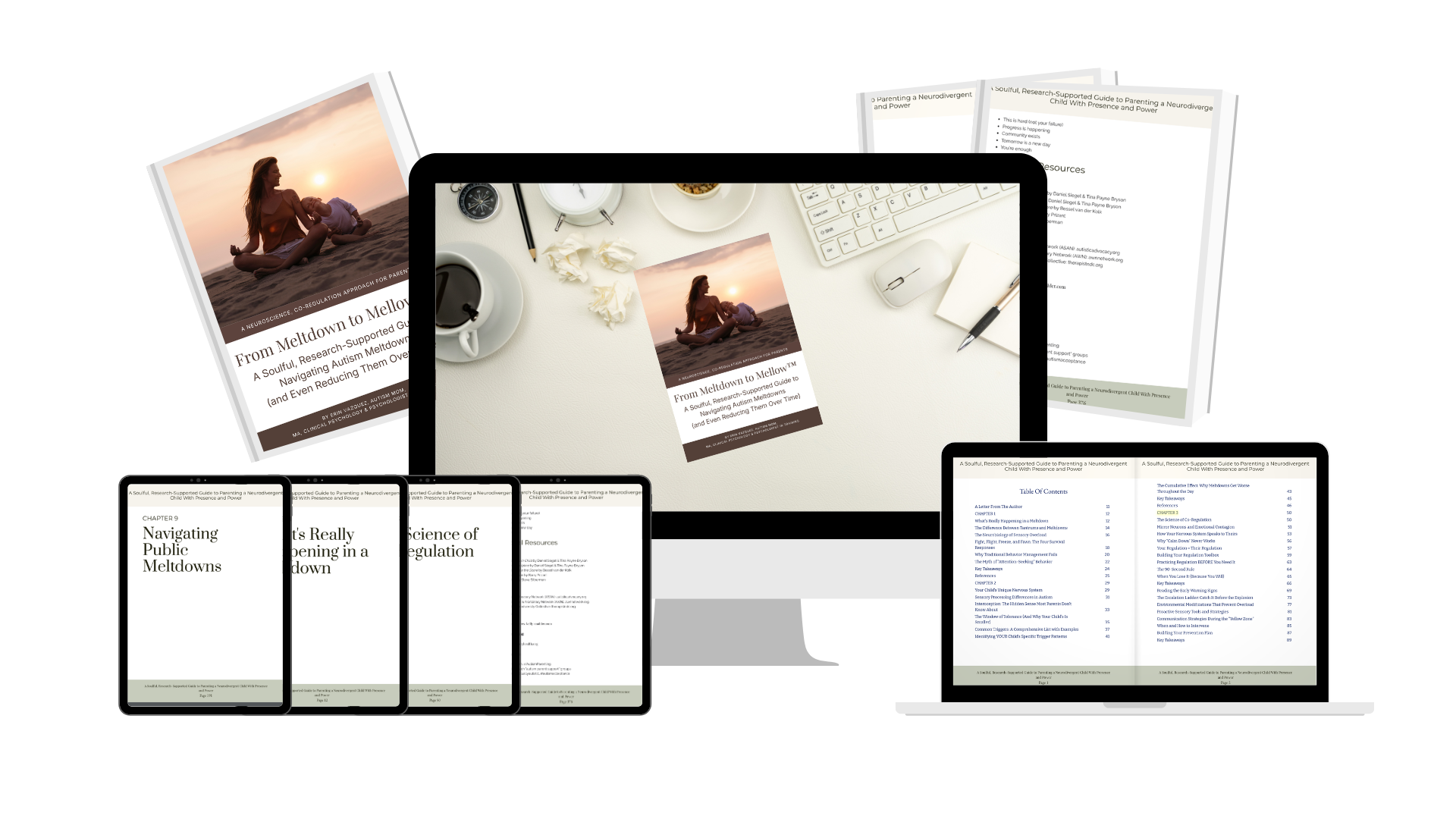
From Meltdown to Mellow™ offers a deeper, step-by-step guide to recognizing triggers, matching sensory support to your child’s needs, reducing sensory load, communicating during crisis, navigating public meltdowns, and protecting your own nervous system in the process.
You can learn more about it here.
References
Case-Smith, J., Weaver, L. L., & Fristad, M. A. (2015). A systematic review of sensory processing interventions for children with autism spectrum disorders. Autism, 19(2), 133–148. https://doi.org/10.1177/1362361313517762
Ismael, N., Lawson, L. M., & Hartwell, J. (2018). Relationship between sensory processing and participation in daily occupations for children with autism spectrum disorder: A systematic review of studies that used Dunn’s sensory processing framework. American Journal of Occupational Therapy, 72(3), 7203205030. https://doi.org/10.5014/ajot.2018.024075
Piller, A., McHugh Conlin, J., Glennon, T. J., Andelin, L., Auld-Wright, K., Teng, K., & Tarver, T. (2025). Systematic review of sensory-based interventions for children and youth, 2015–2024. Frontiers in Pediatrics, 13, 1720179. https://doi.org/10.3389/fped.2025.1720179
Schaaf, R. C., Dumont, R. L., Arbesman, M., & May-Benson, T. A. (2018). Efficacy of occupational therapy using Ayres Sensory Integration®: A systematic review. American Journal of Occupational Therapy, 72(1), 7201190010p1–7201190010p10. https://doi.org/10.5014/ajot.2018.028431
Schoen, S. A., Lane, S. J., Mailloux, Z., May-Benson, T., Parham, L. D., Smith Roley, S., & Schaaf, R. C. (2019). A systematic review of Ayres Sensory Integration intervention for children with autism. Autism Research, 12(1), 6–19. https://doi.org/10.1002/aur.2046
Unwin, K. L., Powell, G., & Jones, C. R. G. (2022). The use of multi-sensory environments with autistic children: Exploring the effect of having control of sensory changes. Autism, 26(6), 1379–1394. https://doi.org/10.1177/13623613211050176